Why True Sustainability is Winning UK Injection Moulding Contracts
 George Nowill
- 5 minutes read

|
Getting your Trinity Audio player ready...
|
For Original Equipment Manufacturers (OEMs) sourcing injection moulded components in the UK, the procurement landscape has fundamentally shifted. Driven by rigorous UK net-zero mandates, consumer pushback on environmental waste, and escalating carbon penalties, manufacturers are realising a critical truth: your product’s environmental footprint is dictated by the carbon footprint of your supply chain.
Sustainability is no longer a localised marketing initiative or a simple tick-box exercise on a tender document. It has matured into an aggressive, board-level technical requirement.
When sourcing plastic components, a technical purchasing team cannot simply look at the unit cost of the part; they must account for the material lifecycle, Scope 3 supply chain emissions and the operational footprint of the moulder itself.
Why ‘Basic’ Sustainability is No Longer Enough
For years, the plastic injection moulding sector viewed sustainability through a very narrow lens—primarily focusing on regrinding factory floor scrap or offering standard biodegradable additives. While those practices are helpful, they represent the absolute bare minimum.
A modern manufacturer seeking long-term supply chain resilience needs data-driven assurance. They must report exactly where materials originate, prove that the manufacturing process minimised energy usage, and guarantee that their components do not carry hidden Environmental, Social, and Governance (ESG) risks.
In a competitive landscape, the injection moulders thriving today are those who look beyond the immediate boundaries of the moulding machine and treat eco-efficiency as a holistic engineering discipline.
How TEX Plastics Goes Beyond the Basics: The Wider Picture
Under the leadership of Managing Director Guy Sentance, TEX Plastics has fundamentally redesigned how a UK injection moulder handles environmental and social governance. Rather than tackling sustainability as a standalone policy, TEX Plastics embeds it directly into its overarching production strategy.
Their operational framework showcases exactly what it means to look at the ‘big picture’ of manufacturing sustainability through several distinct, verified milestones.
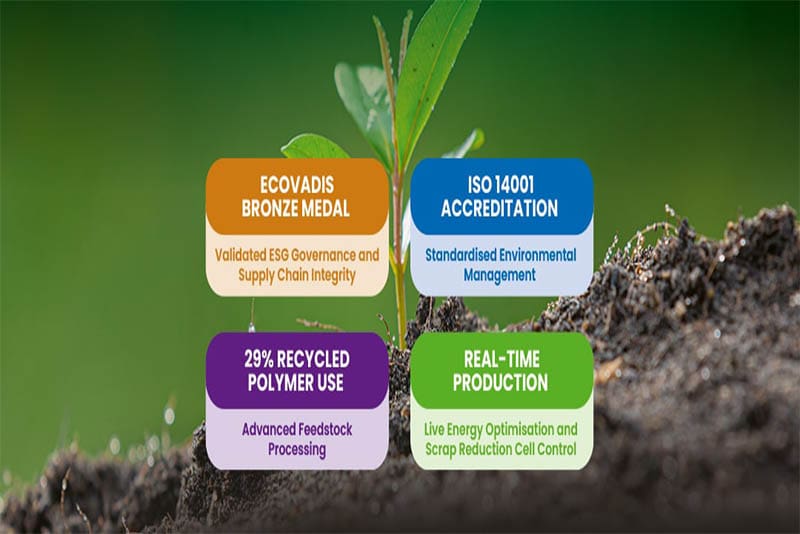
1. Independent ESG Validation: The EcoVadis Bronze Medal
Greenwashing is a major legal and commercial risk for UK manufacturing brands. To give clients undeniable proof of their compliance, TEX Plastics partnered with EcoVadis to rigorously track, audit and report their corporate social responsibility.
By securing the EcoVadis Bronze Medal, TEX Plastics places in the top 35% of all rated companies globally. This rating does not just look at the carbon footprint of a plastic part; it comprehensively audits four critical pillars:
- Environment: Direct machine energy optimisation and waste control
- Labour & Human Rights: Safe, ethical working environments across both the Derby and Barnstaple sites
- Ethics: Complete transparency in corporate governance
- Sustainable Procurement: Ensuring the upstream chemical and material suppliers they use adhere to the exact same high standards
For major OEMs—especially in highly regulated spaces like medical devices, electronics, and automotive tech—this third-party verification provides the crucial data needed to confidently map and report their Scope 3 indirect supply chain emissions.
2. Setting New Feedstock Benchmarks: 29% Recycled Polymer Integration
While many moulders talk about utilising recycled material, processing post-consumer or post-industrial recycled (PIR/PCR) resins at scale is technically difficult. Recycled feedstocks frequently suffer from volatile flow rates and material inconsistencies that can ruin precision tools or cause high defect rates.
TEX Plastics directly addressed this engineering hurdle, setting a distinctive industry benchmark by achieving 29% recycled polymer usage across its active moulding operations. To achieve this without reducing the mechanical performance or aesthetic quality of the final component, the company invested heavily in advanced central granulation systems. This technology allows them to execute closed-loop material reprocessing, instantly capturing, grinding, and blending production offcuts back into live production lines with zero degradation.
3. Energy Optimisation via Real-Time Monitoring
The greenest unit of energy is the one you never use. In an environment where UK industrial energy inflation squeezes margins, reducing the cycle time and kilowatt consumption of an injection moulding run is both an environmental victory and a commercial necessity.
As part of their One Plastics, One Company unified strategy, TEX Plastics rolled out advanced Real-Time Production Monitoring Systems across both their Derby and Barnstaple facilities. Rather than evaluating efficiency retrospectively at the end of a weekly shift, plant managers track production metrics live on the factory floor. If a machine experiences a minor variance in cavity pressure or heating efficiency, the system flags it instantly. This level of process control minimises energy draw, optimises cycle times, and keeps part scrap rates near absolute zero.
4. Systemic Standards: ISO 14001 and Value-Add Onshoring
A holistic approach to sustainability requires international structural compliance. To ensure environmental controls are standardised group-wide, TEX Plastics has achieved formal ISO 14001 accreditation at its Barnstaple facility, mirroring the high operational frameworks utilised at their Derby site.
Furthermore, they look at the broader logistical picture by providing in-house, value-added downstream processes (such as specialised assembly, ultrasonic welding, and surface finishing). By executing these secondary operations directly at the moulding source, TEX Plastics completely eliminates the need to transport half-finished components between multiple external suppliers. This compressed footprint slashes localised freight emissions, minimises transport packaging waste, and drastically simplifies the OEM’s logistics chain.
The Takeaway for UK Product Designers
Sustainability in British manufacturing is no longer defined by simply choosing a bio-plastic from a catalogue. True environmental stewardship means partnering with a moulder whose internal culture, machinery investment, and third-party certifications are geared toward eliminating waste at every step of the lifecycle.
By combining rigorous independent governance like EcoVadis with highly practical manufacturing advancements—like real-time power tracking and high-tier recycled polymer integration—TEX Plastics demonstrates that a greener future for plastics isn’t just possible; it’s already running on the production floor.
Find more news from Tex Plastics here.

Tex Plastics
+44 (0)1332 363249
Website
Email