Metal Replacement: When a Self-Lubricating Plastic Can Replace Metal // LATI Blog
 George Nowill
- 6 minutes read

|
Getting your Trinity Audio player ready...
|
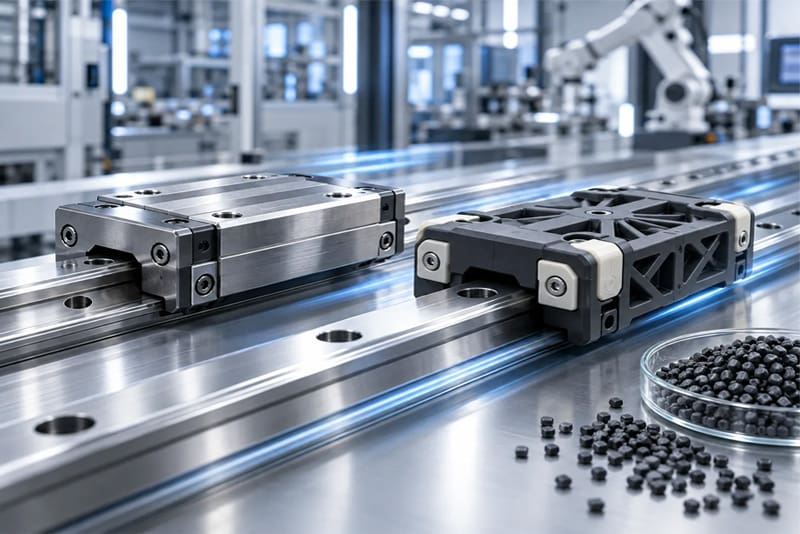
A metal component requires machining, an additional bushing, lubrication and multiple assembly steps. Going further, a metal component can simply be too heavy for a system that must accelerate and decelerate thousands of times. At that point, the question almost inevitably arises: can we make it in plastic? LATI explores this question.
The answer does not depend solely on comparing the strength of metal against that of the polymer. A successful metal replacement starts from the component’s function and redesigns the system by taking into account the specific characteristics of thermoplastic materials.
The Basic Principle
Metal replacement does not mean copying the metal geometry and simply changing the material. It means redesigning the part to take advantage of moulding, functional integration and compound properties, while keeping creep, temperature, tolerances and tribology under control.
Why Metal Geometry Should Not Be Transferred Automatically
Metals and polymers have different elastic moduli, thermal expansion, creep behaviour, heat conduction and failure modes. In reinforced compounds, fibre orientation introduced by moulding also comes into play, which can make the behaviour anisotropic.
For this reason, a geometry that works well in steel may be poorly suited to plastic. Ribs, radii, wall thicknesses, gate locations, flow direction and functional integration must all be rethought together with the choice of matrix and reinforcement.
In Moving Components There Is an Additional Challenge: Tribology
A static bracket only has to support a load. A bushing, cam, guide or gear must support the load while simultaneously maintaining a stable interface over a high number of cycles. The structural and tribological aspects cannot be separated.
The material must therefore be selected not only for modulus and strength, but also for friction, wear, counterpart, pressure, speed, temperature and quality of motion.
The Five Functions to Map Before Redesign
1. Structural Function
What loads must the component withstand? Are they static, cyclic, or impulsive? What deformation is acceptable? What margin is needed against creep and fatigue?
2. Dimensional Function
What tolerances must be maintained over time and at operating temperature? A dimensional change can alter contact pressure and clearance, which in turn can trigger more friction or wear.
3. Tribological Function
Against which material does the sliding occur? At what pressure, speed and type of motion? What service life is required, and what end-of-life mode is acceptable?
4. Thermal Function
How much heat comes from the environment, and how much is generated by friction? Moving from metal to a polymer changes the heat dissipation capacity. The thermal balance must therefore be verified, especially in high-speed or high-load applications.
5. Manufacturing Function
The value of metal replacement often comes from the ability to integrate multiple elements into a single moulded part: seats, clips, guides, end-stops, connecting elements, or functions that previously required separate machining and assembly operations.
The Business Case Is Not Built on Cost per Kilogram
Comparing the price of the compound with the price of metal per kilogram can lead to the wrong decision. The comparison should instead be made at the level of system and process cost.
- the actual quantity of material used;
- machining and finishing operations;
- number of components;
- additional inserts, bushings or bearings;
- assembly operations;
- initial lubrication and maintenance;
- mass and inertia of the component;
- scrap and logistical complexity;
- cycle time and production volumes.
A technical compound may cost more per kilogram but result in a component that is simpler, lighter and faster to produce. This is the correct level at which to evaluate the project.
More Reinforcement Does Not Automatically Mean Better Tribology
To increase stiffness and strength, a common solution is to use glass or carbon fibres. This is often an effective choice from a structural standpoint, but the interface must be carefully verified.
Reinforcement can alter the surface hardness and abrasiveness of the compound. In some configurations, especially against relatively sensitive metals, this can increase wear on the counterpart. Selection must therefore strike a balance between structural load-bearing capacity and tribological behaviour.
Where a Self-Lubricating Compound Comes into Play
In components with relative motion, integrating the self-lubricating function into the material can reduce the need to add bushings, coatings or external lubricants. This can simplify the component, but it requires selecting the right combination of matrix, reinforcement and tribological system.
The LATILUB family includes solutions based on different matrices, including for structural and high-temperature applications. The advantage lies not in having a “plastic material instead of metal”, but in being able to tailor the compound’s properties to the complete set of requirements.
A Seven-Step Metal Replacement Process
- Map all the functions of the current metal component, including those that are not obvious.
- Define the system of applied loads, temperature, service life, tolerances and safety requirements.
- Describe the tribological requirements: pressure, speed, motion, counterpart, surface and environment.
- Select an initial material architecture: matrix, reinforcement and self-lubricating system.
- Redesign the geometry for polymer behaviour and for moulding.
- Use simulation and prototyping to verify deformation, flow, orientation and critical points.
- Validate the component through functional testing, endurance testing and process industrialisation.
Three Signs That Metal Replacement Needs Further Investigation Before Proceeding
- The metal’s heat dissipation is essential to the component’s function and has not yet been compensated for in the new design.
- The required stiffness demands deformations well below those realistically achievable with the selected polymer.
- The tribological contact has not been defined: data on load, speed, counterpart, temperature or required service life are missing.
In these cases, the correct response may be to modify the geometry, change the matrix, maintain a hybrid solution, or forgo the replacement altogether. An effective metal replacement does not start from a requirement to use plastic: it starts from demonstrating that the redesigned system meets the requirements.
From Material to Application Feasibility
The real advantage for a technical office is reducing the number of iterations needed to reach a solution that can be validated. Co-design, simulation, material characterisation, tribological testing and moulding support make it possible to address simultaneously the variables that make the transition from metal to plastic riskier.
Are You Considering Metal Replacement for a Moving Component?
By using the LATI Tribology Design Check, you can share the geometry, current metal material, load and temperature conditions, tribological contact, required service life, volumes and redesign objective. The first step is to verify feasibility and identify critical issues before selecting the compound.

LATI
+44 (0) 1270 501713
Website
Email