LATI Innovation Day 2026: Industry and Research Come Together to Discuss Self-Lubricating Compounds and PTFE Alternatives
 George Nowill
- 5 minutes read

|
Getting your Trinity Audio player ready...
|
What performance will tomorrow’s self-lubricating compounds need to deliver? How can alternatives to PTFE be evaluated without overlooking mechanical strength, thermal behaviour and component durability? LATI dedicated its Innovation Day 2026 to these questions, bringing together technicians, engineers and researchers from several European countries in Varese on 23 and 24 September.
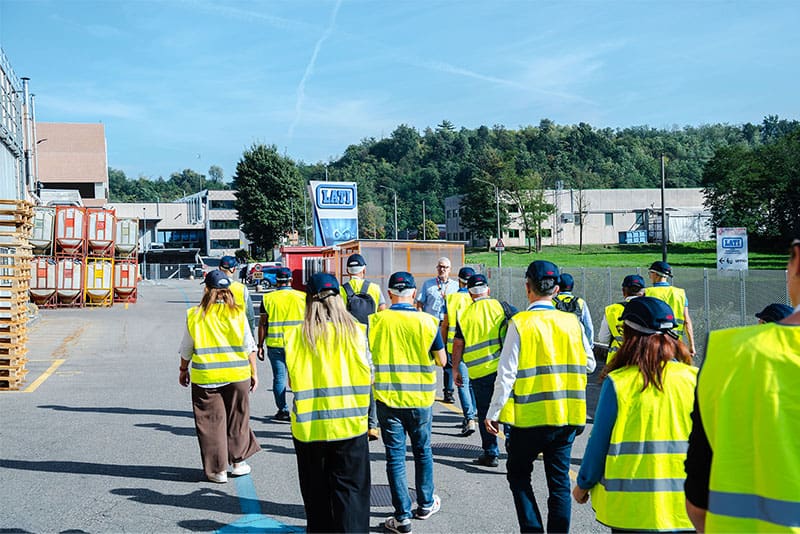
The company revived its technical meeting format, combining scientific contributions, application cases and professional discussion. The welcome session on 23 September opened the dialogue among participants, which continued the following day with sessions at Hotel Capolago and a visit to LATI’s production plant in Gornate Olona.
The event was opened by Alessio Portentoso, Group Sales Director at LATI. His introductory speech connected market transformations with material development choices, investments in plant modernisation and collaboration across the value chain. Innovation Day was presented as a space for sharing application challenges, results and development needs.
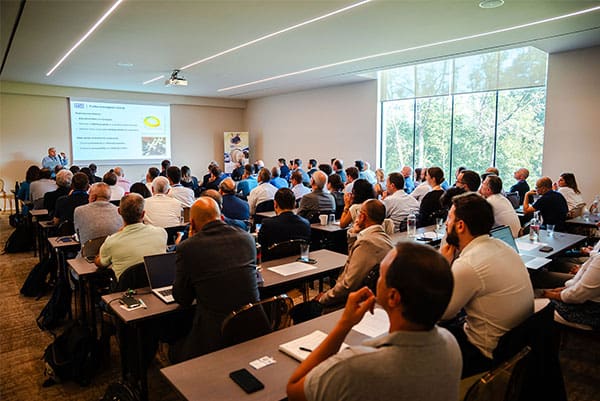
“Bringing back Innovation Day means creating an opportunity for joint work between those who develop materials, those who follow regulatory aspects, component designers and those who validate performance. Industrial transformations require new solutions, but also a greater ability to share information and expertise. Direct dialogue with customers, researchers and partners helps us guide development towards real application needs, according to an Open Innovation approach that involves the entire value chain,” said Alessio Portentoso, Group Sales Director at LATI.
The presentation by Luca Posca, Group Technical Assistance & Marketing Director at LATI, entitled ‘Self-lubricating compounds looking toward the future’, explored experimental work on alternatives to PTFE. 1 The presentation illustrated the LATILUB E family, based on UHMWPE additives — ultra-high molecular weight polyethylene, and the LATILUB P family, based on alternative polymer solutions.
The discussion focused not only on friction and wear, but also on processability, mechanical properties, thermal stability and long-term reliability. The experimental activities include pinon-disc and reciprocating motion tests, with reference to ASTM G99 and ASTM G133 methods, to evaluate material behaviour under different sliding conditions.
The results presented show that specific formulations can achieve tribological performance comparable to PTFE-containing references under the test conditions considered. However, the effects on mechanical and thermal properties remain decisive: a favourable result in terms of friction and wear does not automatically imply suitability for high temperatures or demanding thermomechanical stresses.
“Replacing PTFE cannot be assessed solely through the coefficient of friction. Wear, temperature, mechanical stresses, contact surfaces and required service life must all be considered together. Alternatives are delivering interesting results, but there is no universal solution. Our work consists in identifying the most suitable combination of matrix and additives and verifying it under conditions representative of real use,” commented Luca Posca, Group Technical Assistance & Marketing Director at LATI.
Davide Lotti, Product Sustainability and Analysis Manager at LATI, addressed the industrial implications of the European regulatory pathway on PFAS with ‘EU PFAS Regulations: Challenges and Opportunities for Industry’. His presentation focused on the challenges of qualification and substitution, the collection of technical evidence and timely communication between suppliers, compounders and users. The importance of distinguishing proposals currently under assessment from formally defined obligations was also highlighted.
The link between material characterisation and component behaviour was explored by Damijan Zorko, CEO of RD Motion, with ‘Plastic Gears: From Material Selection to Performance and Durability’. His contribution connected material selection, temperature, fatigue and wear in the design of plastic gears, integrating innovative analytical methods and experimental validation.
Eymard Houara Komba, Tribology Scientific Expert at FORVIA, presented ‘Tribological Characterization Methodology for Reliable Material Selection’. Starting from steel-polymer interfaces in automotive seats, he illustrated a methodology combining tribological testing, surface characterisation and damage analysis to support the evaluation of PFAS-free alternatives, also exploring traditional polymers.
With ‘PFAS in plastic industry’, Sonia Serroukh, Materials & Recycling Project Manager at CT IPC, illustrated the contribution of collective research to understanding PFAS uses and developing transition strategies for companies across the plastics value chain.
Application experience was at the centre of the presentation by Michela Marchiorato, Purchasing Manager at Cebi Micromotors Switzerland SA, ‘Innovation Through Partnership: Turning Material Challenges into Opportunities’. The collaboration case between CEBI and LATI in the development and validation of an alternative plastic material highlighted the role of complementary expertise and dialogue between customer and supplier.
The academic perspective was provided by Professor Stefano Turri, Full Professor of Materials Science and Technology at the Department of Chemistry, Materials and Chemical Engineering ‘Giulio Natta’ of Politecnico di Milano, with ‘Self-lubricating thermoplastic compounds – Replacing PTFE with alternative solutions’, dedicated to alternatives to PTFE in self-lubricating thermoplastic compounds.
The Q&A sessions and meetings with speakers provided space for further discussion of participants’ specific needs. The introduction by Diego Imbrighi, Group Technology Innovation Director at LATI, and the visit to the Gornate Olona plant completed the programme, connecting material research, application development and industrial production.
With the return of Innovation Day, LATI renews a space for training and knowledge sharing in which tomorrow’s solutions are discussed together with those who study, process and use them. The common thread is the need to connect formulation, testing methods and operating conditions, so that material innovation is reflected in actual component performance.

LATI
+44 (0) 1270 501713
Website
Email