Strengthening PFAS Risk Assessment with TOF Analysis
 George Nowill
- 3 minutes read

|
Getting your Trinity Audio player ready...
|
Norner is introducing a new analytical capability: Total Organic Fluorine (TOF) analysis by Pyrolysis-GC/MS, further strengthening PFAS screening and regulatory support for materials and articles.
As regulatory attention on PFAS is increasing rapidly, particularly under the EU PPWR (Packaging and Packaging Waste Regulation), the plastic industry is required to demonstrate that materials and articles do not exceed PFAS-related limits, even when the exact substances present are unknown.
New Analytical Capability
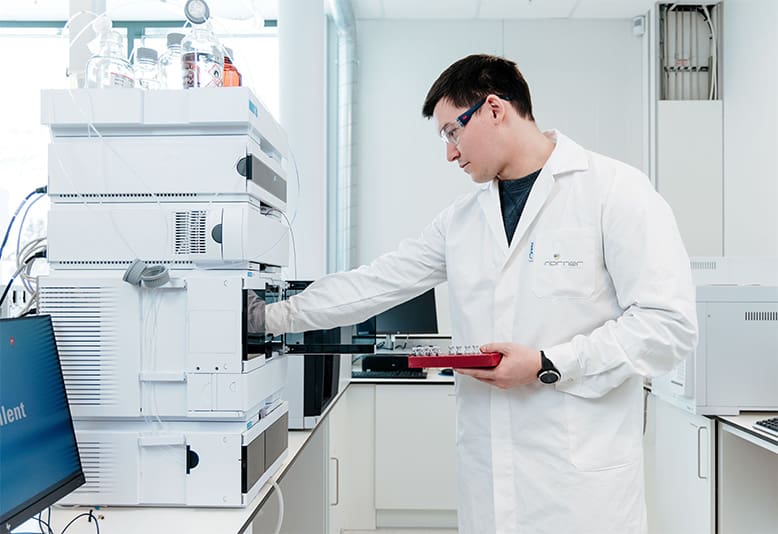
Norner is introducing a new analytical capability: Total Organic Fluorine (TOF) analysis by Pyrolysis-GC/MS, further strengthening PFAS screening and regulatory support for materials and articles. Total Fluorine (TF) is often proposed as a standardised initial screening tool, but it will detect both organic and inorganic fluorine. PPWR is concerned with PFAS which are organic fluorine and therefore we focus on more selective and relevant PFAS analytical approaches, offering TOF analysis and PFAS target analysis to support defensible, risk-based decision making.
What Is TOF and Why It Matters
TOF measures organic fluorine, providing a more relevant indicator of potential PFAS presence than bulk fluorine measurements alone. By excluding inorganic fluorine, TOF helps reduce false reassurance and supports better prioritisation for further PFAS testing. If TOF is confirmed <50ppm, the product is compliant with PPWR.
TOF is determined using Pyrolysis-GC/MS, enabling:
- Direct analysis of solid materials without solvent extraction
- Robust screening of complex polymeric and composite materials
- Fast turnaround times suitable for compliance and product development needs
TOF can be used as a standalone screening tool or in combination with PFAS analysis, depending on the regulatory context and customer needs. This enables a risk-based and cost-efficient testing strategy, avoiding unnecessary advanced analysis while maintaining regulatory robustness.
Understanding TF, TOF and PFAS Enforcement
The PPWR enforcement logic follows a stepwise concept, moving from broad fluorine measurements toward compound-specific PFAS evaluation, as illustrated in figure 1.
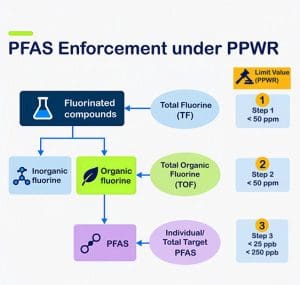
TF represents total fluorine from all sources, including inorganic and organic fluorine. TOF is a subset of TF, focusing only on organic fluorine, which is directly relevant for PFAS. The final step involves targeted or total PFAS analysis, where individual PFAS compounds are identified and quantified against regulatory limits.
How Norner Supports PFAS Screening
- TOF analysis by Py-GC/MS
- Targeted and non-target PFAS screening by LC/QTOF
TOF can be used as a standalone screening tool or in combination with PFAS analysis, depending on the regulatory context and customer needs. This enables a risk-based and cost-efficient testing strategy, avoiding unnecessary advanced analysis while maintaining regulatory robustness.
Typical Application Areas
The TOF method is suitable for a wide range of materials, including:
- Plastics and polymer compounds
- Coatings, elastomers, and composites
- Recycled materials and articles with unknown PFAS history
Contact Norner for Further Information on PFAS Screening
Bavan Mylvaganam: bavan.mylvaganam@norner.no
Siri Stabel Olsen: siri.stabel.olsen@norner.no

Norner
+47 35 57 80 00
Website
Email