How Tex Plastics’ Automated DOPAG Foam Gasketing System Protects Critical Components
 George Nowill
- 10 minutes read

|
Getting your Trinity Audio player ready...
|
Tex Plastics highlights the importance of preventing dust and moisture ingress in modern manufacturing. For products deployed in outdoor, wet, or harsh industrial environments, relying on manual rubber gaskets or peel-and-stick foam seals introduces human error, high assembly labour, and risk of seal failure over time.
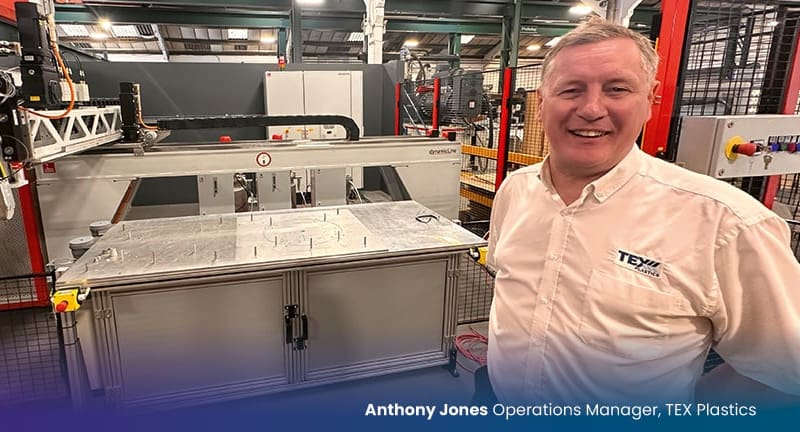
To eliminate these vulnerabilities, Tex Plastics has invested in an advanced robotic sealing system at its Derby facility. Featuring cutting-edge technology from DOPAG—a world leader in metering and mixing systems—this fully automated, chemically cured foam gasketing cell is installed, tested, and actively adding value to injection-moulded components.
Automated Formed-in-Place Foam Gasketing (FIPFG): How It Works
Unlike traditional pre-formed die-cut gaskets that must be manually glued or fitted into a groove, Formed-in-Place Foam Gasketing (FIPFG) dispenses a liquid polyurethane or silicone seal directly onto the moulded plastic component.
Driven by precision robotics, the DOPAG machine dispenses a micro-precise bead along complex 2D or 3D contours. A controlled chemical reaction then takes place: this chemical cure creates a seamless, joint-free seal that adheres directly to the plastic substrate—ensuring zero gaps for water or dust to penetrate.
Meeting Rigorous IPX Water Ingress Regulations
For original equipment manufacturers (OEMs), achieving compliance with international Ingress Protection (IP) standards—specifically IPX5, IPX6, IPX7, and IPX8 water ingress regulations—is vital. The DOPAG automated foam sealing technology provides the high-precision tolerances needed to pass strict IP testing:
| Ingress Rating | Protection Level Target | Traditional Manual Gaskets | Tex Plastics DOPAG Robotic FIPFG |
|---|---|---|---|
| IPX5 & IPX6 | Water jets & heavy seas | Risk of joint leaks & alignment errors | Continuous, seam-free barrier prevents water penetration |
| IPX7 & IPX8 | Full water immersion | Adhesive degradation & seal displacement | Chemically bonded foam maintains seal pressure under depth |
| Tolerance | Dimensional consistency | Variable (dependent on operator skill) | High repeatability across millions of cycles |
Key Sectors and Applications
The addition of this fully integrated robotic sealing cell provides an immediate advantage for clients operating in demanding technical markets:
- Life-Critical & Fire Security: Sensor enclosures, outdoor alarms, and emergency call points that must withstand heavy rainfall and humidity without internal short-circuiting.
- HVAC & Heat Pumps: Outdoor heat pump covers, air handling access doors, and electrical control boxes requiring weather-tight protection against seasonal driving rain and ice.
- Electronics & Industrial Enclosures: Junction boxes, terminal housings, and smart metering devices deployed in wash-down or high-dust industrial environments.
- Automotive & Outdoor Lighting: Exterior light clusters, mirror housings, and under-hood electronic control units (ECUs).
Eliminating Supply Chain Friction with Single-Source Efficiency
Integrating automated DOPAG sealing directly alongside Tex Plastics’ injection moulding production provides significant commercial value for OEMs. Rather than moulding plastic parts at one facility and shipping them to a second supplier for secondary seal application, Tex Plastics manages the entire process under one roof.
- Lower Transport Costs: Eliminates secondary shipping and handling fees between suppliers.
- Reduced Lead Times: Components are moulded, sealed, cured, and packed in a streamlined continuous workflow.
- Unified Quality Assurance: Total accountability under Tex Plastics’ ISO-certified quality management framework.
By bringing advanced robotic foam gasketing in-house, Tex Plastics enables manufacturers to raise their product protection standards while simplifying their supply chains.
When the Seal Is Part of the Product – Not an Afterthought
Many injection moulded components are ultimately assembled into products that need protection against the external environment. Electrical and electronic housings are obvious examples. So too are components used in water heating equipment, industrial catering equipment, traffic control systems and other technical applications. In these products, the interface between two components can be just as important as the components themselves.
A housing may have excellent dimensional accuracy and a robust design, but if the joint between two mating surfaces allows moisture to enter, the performance of the finished assembly can be compromised.
The IP Code, defined by IEC 60529, provides a recognised system for classifying the degree of protection provided by enclosures. The second digit of an IP rating relates specifically to protection against water ingress.
This makes the sealing strategy an important part of product design – particularly where equipment is exposed to water, splashing, condensation or challenging operating environments.
A New Option for Designers of IP-Rated Products
For an OEM developing a new enclosure or technical moulding, there can be several ways of creating a seal.
- A separate gasket can be manufactured and supplied to the assembly line. It can then be positioned manually or automatically before the enclosure is closed.
- Alternatively, a foam gasket can be applied directly to the moulded component.
This is the principle behind Formed-In-Place Foam Gasketing (FIPFG).
The sealing material is metered and mixed before being applied precisely along a programmed path on the component. DOPAG’s technology uses a dynamic mixing system and robotic application to create the gasket directly on the part. Depending on the material system, the resulting foam seal cures at room temperature through a chemical reaction rather than requiring oven curing.
For the customer, this opens up an important design question:
Could the sealing operation become part of the injection moulding supply solution rather than another operation somewhere else in the supply chain?
Precision Where Consistency Matters
One of the biggest advantages of automated gasket application is repeatability.
- A manually applied gasket introduces opportunities for variation. Position, bead size, joining points, compression and operator technique can all influence the finished result.
- An automated system, by contrast, can control the metering, mixing and positioning of the sealing material. DOPAG identifies precise and reproducible application, process stability, reduced material waste and lower operator intervention among the benefits of its automated technology.
For technical injection moulding customers, that consistency can be particularly valuable. The objective isn’t simply to put a bead of foam onto a plastic component. The objective is to put the right amount of material, in the right position, with the right geometry, repeatedly. That can make a difference to the reliability of the finished assembly.
Why This Matters for Water Ingress and IP Protection
Where a product has an IP protection requirement, sealing becomes a critical part of the overall design.
- A gasket needs to follow the intended sealing surface accurately and maintain the required interface when the product is assembled.
- A formed-in-place gasket has an additional advantage: it can be applied to complex geometries and can be designed around the actual component rather than relying on a separately manufactured gasket profile. DOPAG states that its FIPFG process can seal three-dimensional components and complex shapes, with gasket width, height and hardness among the parameters that can be influenced.
For product designers, this can create greater freedom when developing the moulding itself. Instead of designing the plastic component around an off-the-shelf gasket, there is the potential to consider the moulding and gasket as one engineered system.
That is where Tex Plastics’ injection moulding expertise becomes particularly relevant.
Adding Value to the Moulding
The commercial opportunity is bigger than simply adding another manufacturing process. A customer approaching Tex Plastics with an injection moulded component that requires sealing can potentially have more of the manufacturing process managed through one technical supply partner.
The component can be injection moulded, transferred through the value-added operation and receive its automated foam gasket. That creates a more complete finished component.
For an OEM, this could mean fewer manufacturing stages to manage internally, reduced handling and a simpler supply chain. It may also allow the customer to receive a component that is closer to its final assembly requirement.
This is particularly relevant when the seal is integral to the performance of the product rather than simply an assembly convenience.
Replacing Oven Curing with Chemical Curing
The new Tex Plastics installation also addresses an important production issue. Previously, sealing operations requiring oven curing introduced an additional stage into production. Components had to be handled, transferred for curing and held until the process was complete.
The new DOPAG system uses a chemically curing sealing process, removing the requirement for oven curing. Tex Plastics says this eliminates a production bottleneck, reduces energy associated with heated curing and allows components to progress through production more quickly.
DOPAG’s FIPFG technology similarly describes room-temperature curing, with curing time dependent on factors including the material formulation and environmental conditions. For higher-volume programmes, these process improvements can become commercially significant.
More consistent application + less manual intervention + removal of oven curing = a potentially more efficient way of producing sealed moulded components.
Which Customers Could Benefit?
The technology is particularly relevant to manufacturers where the injection moulded component needs to perform a sealing function.
Potential applications include:
Electrical and Electronic Enclosures
Where housings need protection from water, dust or environmental contamination, an accurately applied foam gasket can become an important part of the enclosure design.
Water Heating and Heating Equipment
Tex Plastics already supplies technically demanding moulded components into the heating sector. Adding automated sealing capability provides another option for components where environmental protection and reliable interfaces are important.
Industrial Catering Equipment
Equipment operating around water, cleaning processes and demanding commercial environments can place particular importance on sealing and component durability.
Traffic Control and Outdoor Equipment
Outdoor products can be exposed to rain, moisture and changing environmental conditions. Sealed moulded housings can help protect internal components.
Control Systems and Electrical Equipment
Where sensitive electronics need protection within a plastic enclosure, the joint between enclosure components can be a critical design consideration.
OEMs Replacing Manually Fitted Gaskets
Perhaps the most obvious opportunity is for manufacturers currently applying seals manually and looking for greater repeatability, reduced handling and improved production efficiency.
It Could Also Change the Way a Component Is Designed
The biggest opportunity may actually come much earlier in the process – during product development. When injection moulding and automated sealing are considered together, designers can work with the geometry of the moulded component and the gasket application as a combined solution.
The location of the sealing groove, the available surface area, corners and radii, fixing points, wall geometry and assembly method can all be considered alongside the automated gasket process. That is where Design for Manufacture becomes important. Rather than designing a plastic part first and attempting to work out how to seal it later, the injection moulding and sealing requirements can be considered together. For customers, this can help turn a plastic moulding into a manufactured, sealed and production-ready component.
From Component Supplier to Manufacturing Partner
Tex Plastics’ new DOPAG installation is therefore significant not simply because it represents another piece of equipment at the Derby facility. It expands what the company can offer around the injection moulded component.
Tex already provides injection moulding alongside tooling, Design for Manufacture and value-added post-mould operations. The automated sealing capability adds another potential stage to that manufacturing proposition.
For customers, the question is not necessarily whether they need a DOPAG system.
They don’t.
The question is whether their product would benefit from having the sealing process engineered and controlled as part of the injection moulding supply solution.
Where water ingress, IP protection, repeatability, production efficiency or assembly costs are important, the answer could be yes.
A Capability That Is Ready for Customer Projects
The important point for prospective customers is that this is no longer a future capability or an investment awaiting installation. The DOPAG robotic sealing system is now installed, tested and operational at Tex Plastics’ Derby facility. That means OEMs and product designers can now explore how automated foam gasketing could be incorporated into their own moulded components – from the early design stage through to production.
The result could be more than a better way of applying a gasket. It could be an opportunity to rethink the component itself, simplify the manufacturing route and add another layer of technical value to an injection moulded product.
For manufacturers developing the next generation of sealed technical products, automated gasketing is now another capability available from Tex Plastics.
Find more news from Tex Plastics here.

Tex Plastics
+44 (0)1332 363249
Website
Email