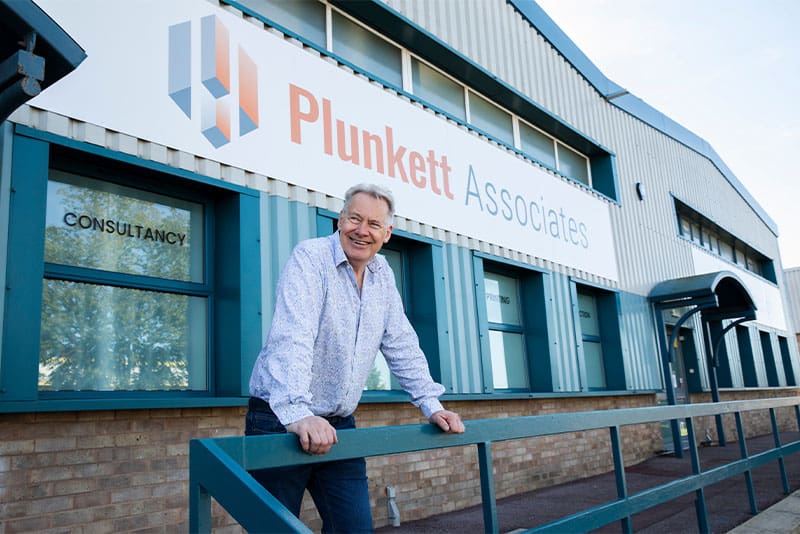
HotSeat Revisited – Tim Plunkett, Owner & Director at Plunkett Associates
 George Nowill
- 8 minutes read

|
Getting your Trinity Audio player ready...
|
Seven years after Tim Plunkett first faced the PlastikMedia HotSeat, we welcome the Plunkett Associates Owner & Director back to find out what’s changed. From the growth of the company’s tooling and moulding operations to automation, sustainability and the changing pressures facing UK manufacturers, Tim revisits the topics shaping the industry then and now. It’s time for Tim Plunkett to face the HotSeat once again…
What have been the most significant developments at Plunkett Associates over the past seven years?
Are your core focuses the same?
Without doubt the growth of our tooling and moulding operations which have increased significantly and now dominate our prototyping activities. We now run 8 moulding machines ranging from 6 to 260 T clamp force and allow us to mould parts from less than 1 gram to circa 800 grams. In parallel we have built a team of people to assemble and pack the product, and they now have a dedicated 1500 square foot assembly area. We actively manufacture tools both in the UK and China using subcontractors and our inhouse toolroom.
To accommodate this we had to move to new premises 5 years ago as we had seriously outgrown our previous base. As is often the case the building seemed huge when we moved in, however now we must think seriously before every new equipment purchase.
Our staff have also increased, but not as much as one might expect as we are constantly looking to automate tasks. We have not crossed that magic threshold where there are more robots than people!
As noted earlier, we were prototyping-focused, using many additive/3D-printed parts, and were very involved in product development. Our focus shifted as many of those products came to fruition, and we followed the projects through to moulding and volume assembly.
That said, the cycle now appears to be swinging back: we are seeing more product development and small-batch production, and less long-running production work. We have always aimed to respond to customer needs, and that built-in agility enables us to flex with demand.
In 2019 we asked you about the issues and trends that will shape the future of the plastics industry in the UK.
How did Plunkett navigate this period? What lessons were learned?
I remember talking then about being “in the middle of a very turbulent period in international trade”, sounds familiar today as well. The unpredictable nature of tariffs and tensions over supply routes did improve, but are back with us today.
Sourcing material on a 20-week lead-time to meet customer demand that is unpredictable, erratic and inconsistent remains a challenge! I think as time goes on the expectation of shorter lead-times is inconsistent with ever decreasing stock levels throughout the supply chain and will inevitably result in disappointment. How this demand is reconciled with the practical issues associated with manufacturing I am unsure.
The old philosophy that it’s the supplier’s problem became unsustainable a while back. I believe the only way to build any confidence is through integration, to actively explore projections and limits with customers, to stock material and parts at levels that are agreed. This gives everyone visibility of what is possible and what the risks are.
Were there any long-term knock-on effects for you and the wider industry?
Are the effects of supply chain disruption still being felt today?
We navigated this time and benefitted from the fact that we were growing, which I believe, makes life easier. That said, years on we are still using some of the material stocks we put aside to protect us from supply disruption.
Sustainability was another theme you mentioned. I think it’s fair to say it has become a more prominent topic. How do you address sustainability concerns for your clients?
Is sustainability an opportunity/advantage for UK manufacturers, when compared with international alternatives?
Sustainability is on everyone’s mind however, what I find interesting is how long it stays there when economics must be addressed at the same time. What starts as a worthy objective is often lost when costs are analysed.
Most customers want to address sustainability while also reducing product cost. This is far more challenging and needs to be embedded in a new product from the outset, as it goes far beyond using recycled material and must address the entire product life cycle.
Is it an opportunity? Yes, but the playing field is uneven today, and the rules and terminology are confusing.
Your final theme from the 2019 interview was the adoption of automation.
Do you think we have seen the level of adoption you expected? Why / Why not?
I still firmly believe automation offers huge potential. However, adoption isn’t going as fast as I expected, and this is largely a cost issue. Much of the equipment is priced on what the vendor sees it replacing, or the number of shifts’ worth of capacity it will open up.
As an SME running short batches, we need both flexibility and a cost point that allows us not to use it. By which I mean that we run a batch, and it might then sit idle for a period before the next batch. Arguing that flexibility and the ability to re-task don’t always work, because it assumes access to programming expertise.
The big shake-up here is the ability to use AI to program; this will impact re-tasking to some degree, but we’ll still be reliant on the next job being suitable.
How has Plunkett Associates approached automation adoption over the past 10 years?
How have your expectations around automation changed?
Over the last 10 years, automation has moved from a ‘nice to have’ to a ‘must have’, and our expectations have changed about what is possible. We have never been able to spend six figures on an automation solution, no matter how flexible. We now understand that if we are going to achieve what we need, we will probably do it ourselves!
Are sustainability and automation still the hot topics within the industry today?
Are there any new trends that you think will shape the future of the UK manufacturing industry?
Probably not as much as factors affecting our cost base, such as raw material costs, energy, rates, wages, etc. The major topics right now are building a predictable cost base to operate from. Controlling these allows us to pursue automation, sustainability, and growth.
Developing automation that untethers a robot from a fixed point will build on what we already accept from AI and physical robotic arms. These may be humanoid, but I am reluctant to define it that way, as I don’t need the complexity of making a robot ‘walk’ when wheels would be a far more effective/cheaper way to get from A to B.
I can’t help but mention AI in this context, but it’s too early to predict how; there are so many opportunities that need to be explored. As such, we’ll hit a few blind alleys before we uncover the ones that will provide the platform for the next manufacturing revolution.
Plunkett Associates celebrated 20 years in business last year. Over those 21 years of growth, what has been the key to your longevity?
Compared to the early days, can you name one thing you do differently today, and one thing that has remained the same?
Finding a way to give our customers what they need has been paramount. This might not always be what we do, but in those circumstances, we find a solution. Knowing they can tap into our experience and that we will try to identify the best solution keeps them coming back.
One thing that has remained the same is that I still spend far too much of my time at work, or at least working. The challenge of finding a solution is difficult to walk away from!
One thing I do differently – drink decaffeinated coffee!
One thing that has remained the same: a 55-hour working week, with few holiday!
Previously, we asked, “What hidden talents do you have?” and you dodged the question!
What are your talents or passions outside of work?
I can’t think why I dodged that last time!
Talents is a hard one, and I am probably not the best one to answer. I asked my colleagues, and they responded with: a passion for solving problems and never giving up (blushing).
Passions are easier: my family. My wife, who has stuck with me through thick and thin, good times and bad and understands the business, its demands and why I do what I do. Her support and encouragement have always been and continue to be invaluable.
Then, 7 children who have left home, travelled the world, come back, and, most importantly, found a way to build a successful future and establish their independence.
Read more from Plunkett Associates here.

Plunkett Associates
+44 (0)1452 386608
Website
Email