PlastikCity on Tour – Notpla
 Will Clarke
- 15 minutes read
|
Getting your Trinity Audio player ready...
|
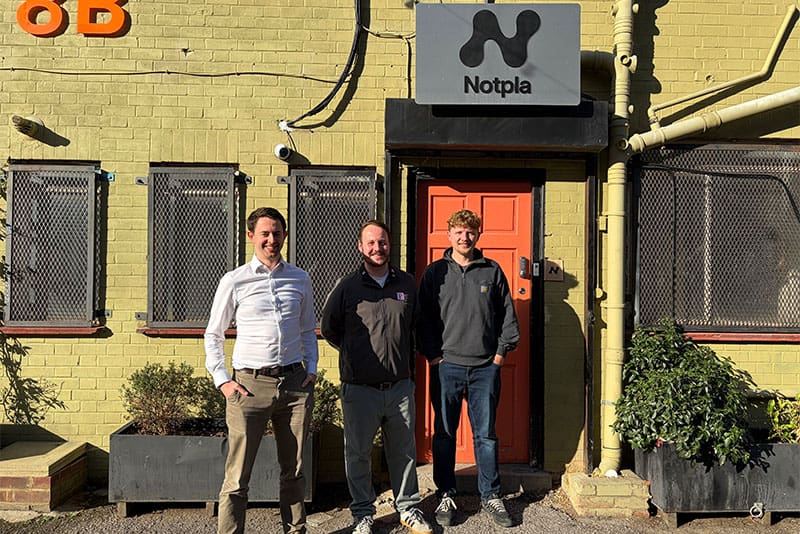
Our next stop was Hackney Wick in London, to visit Notpla and to meet the team developing seaweed-based materials for packaging and moulded products. Will discovered the development work behind Notpla’s bio-based materials, and the opportunities for plastics manufacturers equipped to turn them into commercial products.
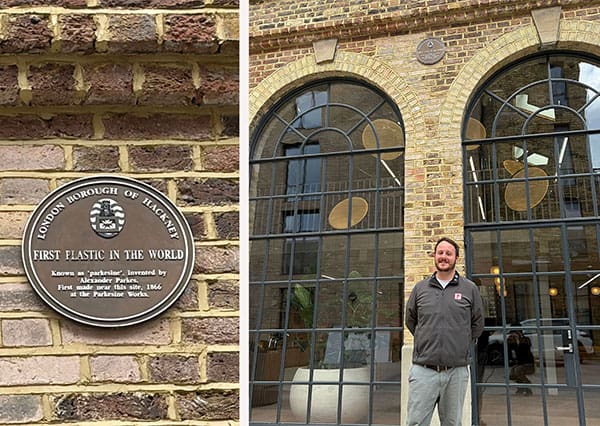
Before exploring the laboratories and production site, the tour took a short detour into the area’s manufacturing history. In the 19th and early 20th centuries, Hackney Wick in East London was a highly industrialised manufacturing hub, with major chemical plants, textile mills and plastics factories. A few minutes’ walk from Notpla’s premises, a plaque commemorates Alexander Parkes and Parkesine, described as the “first plastic in the world”. It records the material’s manufacture at the nearby Parkesine Works in 1866. Created as a low-cost, colorful substitute for natural materials like ivory and tortoiseshell.
Parkesine was ultimately short-lived due to flammability concerns, but its manufacture paved the way for future materials like Xylonite and Celluloid. It was a fitting place to begin. Some 160 years later, material development is still taking place in this part of East London, which has since turned into a creative hub for artists, design studios and craft breweries.
At Notpla, the work centres on naturally derived materials made from seaweed and other natural polymers, that can replace conventional plastics in selected applications, with much of that progress depending on the processing knowledge and equipment developed by the plastics industry.
From kitchen experiments to commercial products
Founded in 2014, Notpla grew from work by Rodrigo Garcia Gonzalez and Pierre Paslier, who met while studying on a joint design engineering master’s programme at the Royal College of Art and Imperial College London. Their early experiments explored whether seaweed could provide an alternative packaging material, taking inspiration from the encapsulation techniques used to make imitation caviar.
The result was Ooho, an edible membrane that holds liquids, including drinks and energy gels. It remains one of the company’s most recognisable products, but an approach from Just Eat helped take the business in another direction. The delivery company wanted an alternative barrier coating for takeaway food boxes, leading to the development of Notpla’s foodservice packaging coatings.
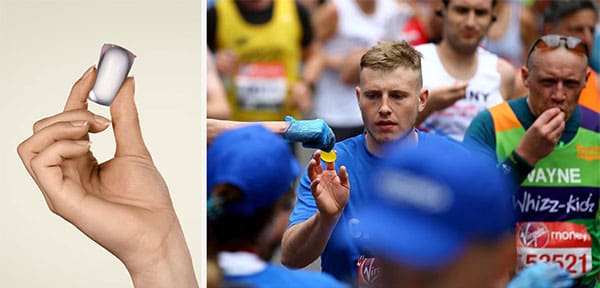
Demand for takeaway packaging during the pandemic accelerated this part of the business greatly, while the events market for Ooho was temporarily curtailed, showing the diversity of applications for seaweed based materials as a key strength for the Notpla team.
Notpla’s food packaging was a particular game-changer for the business, and offered an effective alternative barrier coating for cartonboard products for takeaway food. Traditionally takeaway food was distributed using reusable rigid containers, or plastic coated cartonboard (which proved difficult to recycle and would not biodegrade), but coating cartonboard with Notpla’s seaweed-based coating inferred all the required barrier properties for hot or greasy foods to not penetrate the cardboard. Without compromising food quality or customer experience, this project has reduced plastic waste and represents a -70% CO2e reduction compared to the plastic takeaway tub alternatives.
These coatings won a deluge of awards in the years following, including the prestigious Earthshot Prize. In 2023, Notpla’s coating was the first to be accredited as truly plastic-free by the EU’s notoriously strict Single Use Plastic Directive standards, through a taskforce which was set up by the Dutch government.
Further development broadened the portfolio into films (for window patching), seaweed paper and most recently, an injection-moulding grade commercialised in summer 2024, which crucially, can be moulded in existing machinery with minimal process parameter adjustments.
The company moved from Bethnal Green to its current premises in Hackney Wick during the pandemic. By the time of our visit, the team numbered 56, a diverse team of experts spanning material science, engineering, design and commercial roles. Walking through the large, open-plan office gave me an early indication of the scale of the operation, which proved considerably larger than I had anticipated.
Following a formulation through the building
Technical Category Manager Callum Wardle led the site tour, showing how the team takes a formulation from laboratory experiments through testing and into prototype production.
In the spacious, open-plan laboratory, staff were working with different seaweed-based raw materials, varying their types and proportions to develop material grades with different properties. Familiar polymer testing equipment was used to assess characteristics such as stress and elongation properties to meet specific client criteria. Formulations are evaluated against the needs of the intended application before progressing to the processing area for further development and prototype manufacture.
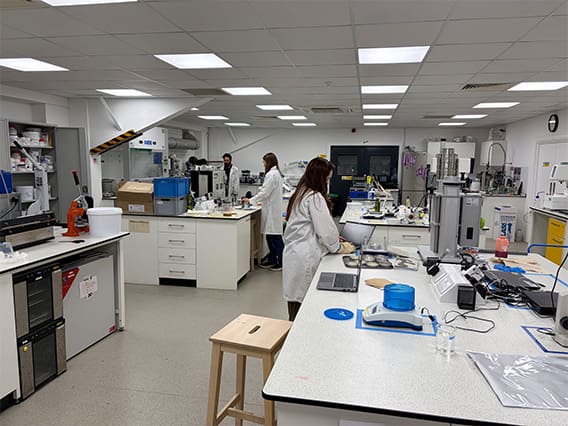
We moved on to see the injection moulding machinery running, alongside the pelletising process and equipment for film and coating development. The extent of the machinery investment was particularly striking. Having these capabilities in-house allows the team to make pellets, mould sample parts and produce films on-site, then use the results to inform the next iteration in a very short time frame.
That has made a substantial difference to development times. Experiments that previously depended on travel and access to external suppliers’ equipment can now take place within the building. The team can investigate and demonstrate new concepts in a matter of days, although validation for commercial production remains a further stage in the process.

Unfortunately, photography was restricted in the production areas because of sensitive development projects and customer work and although we can’t share images of the setup, I was very impressed with the breadth and the high spec of the machinery in the Notpla facility; significant investment has been made over recent years to bring these facilities in-house.
For manufacturers, the significance of this investment is the development work Notpla can complete before asking a partner to commit production time to a trial. Its facilities allow the team to investigate a material’s behaviour and resolve problems on a smaller scale, building evidence that can then support a move to industrial production.
Recognition and the next stage of growth
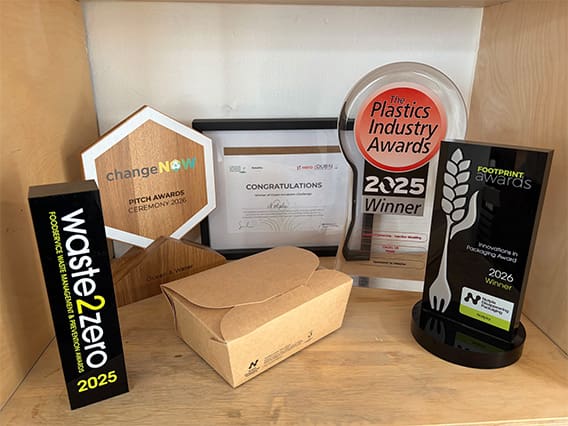
An extensive awards display reflected the attention Notpla’s work has attracted. Its 2022 Earthshot Prize win, in the Build a Waste-Free World category, brought international recognition and helped open discussions with major brands and catering businesses.
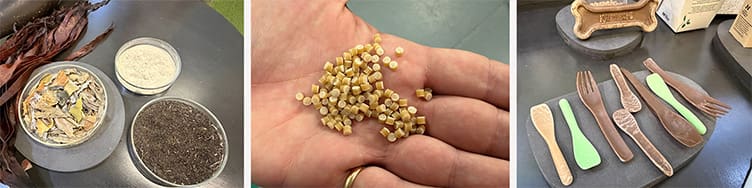
More recent recognition includes Silver for Supplier Innovation of the Year at the 2025 Pentawards, shared with Plastek UK for the Kelpy Bone seaweed-based dog toy. In June 2026, Notpla also received Footprint Awards for Innovation in Packaging, for its SeaView range, and Sustainable Use of Natural Resources, for its work with seaweed.
The shared award with Plastek is particularly relevant to the company’s plans. Despite its growing in-house capabilities, Notpla’s ambition is to supply materials that established manufacturers can convert at scale. Its own equipment supports development, sampling and validation, with production partnerships central to reaching more customers and applications.
To explore what that means in practice, Will spoke with Conor Ludden, Senior Business Development Manager, and Mel Connell, Head of Marketing.
Interview with the Notpla team
Will: What should an injection moulder expect when trying your materials on existing equipment?
Conor: We have developed the materials to work with conventional manufacturing machinery. We knew that if they needed completely new equipment or processes, that would be a major barrier to adoption.
We can run on moulds designed for PP or PE, but that does not mean those tools are optimal for our materials. Tooling and process optimisation makes a significant difference to running continuously and reliably, just like with any material change.
Will: How does the material behave? Does it shrink in the mould? Can you match cycle times of traditional polymers?
Conor: Shrinkage varies with the grade and the part. We tend to see less in-mould shrinkage than with some conventional polymers, but we have also matched conventional plastic cycle times. We have run on multi-cavity hot-runner tools at cycle times of 10 to 15 seconds.
The important point is to assess the material, tool and application together. We understand how costly it is for a manufacturer to stop a line, clean out a machine or deal with a problem during a night shift. Our work has to give partners confidence that they can run the material consistently without overhauling their systems.
Will: Which applications are proving the best fit, and where are the limitations?
Conor: Cutlery was the first commercial application for our injection-moulding grades, and food-contact packaging remains the core of the business. We have also seen growth in pet products, with more brands coming on board, and opportunities in personal care and refill cosmetics.
One important consideration is sensitivity to humidity and moisture. The material can become more flexible over time in humid conditions. That does not mean it is biodegrading, but it can affect its performance, so we need to understand the conditions in which a product will be used.
There are benefits and limitations, and we need to be honest with partners about both. The material has to suit the application and is absolutely not designed to replace every polymer application, but for where it works, it works very well.
We are also interested in uses such as plant clips and golf tees; outdoor products, where an item can be difficult to recover after use and the benefits of biodegradability are clear. There are applications in these areas that we have not yet explored. In some cases, there could be a practical benefit for the customer as well, such as reducing the labour involved in collecting used items.
Will: Why does seaweed remain central to your formulations? Have you tried other feedstocks?
Conor: We work with naturally occurring polymers that have not been chemically modified. We have looked at a number of alternatives over the years, but we keep coming back to seaweed. It grows quickly, does not require freshwater or fertiliser to cultivate, and does not compete with land-based food crops. How it is farmed and harvested matters, and we carry out due diligence with our partners.
There is also a huge range of chemical and physical properties to work with. Different types of seaweed, and different blends, allow us to develop different material characteristics, and there are thousands of seaweed species to experiment with. We use other natural polymers and plant extracts as well, but seaweed is central to what we do.
We’re also pleased with the consistency that seaweed offers. Some natural feedstocks bring challenges, particularly batch-to-batch variation. We have worked hard to understand and control variation within and between batches through our formulations. When the material reaches a manufacturer in pellet form, they should not have to keep changing machine settings to accommodate it and seaweed has offered us this consistency.
Will: How do you approach the end of a product’s life, both for rigid products and coatings combined with paperboard?
Conor: End of life is an important part of how we develop the materials. We design them to break down like a fruit peel, with no specific, industrial conditions required. If they’re left in the environment, or in your garden waste bin at home, they will degrade fully and this is a hugely important part of our product offering.
Dog toys are a good example. They can easily be lost in the garden or left behind in a park. Using a material designed to biodegrade means a lost chew does not leave behind persistent waste. There is also a benefit during use, as the material does not splinter or create shards when chewed. For this application, both how the product behaves when chewed and what happens if it is lost are important considerations.
This is why I see opportunities not only for replacing single-use plastic items like cutlery, but for applications where products can be difficult or expensive to recover after use. Using Notpla for these products completely eliminates the potential for end of life waste.
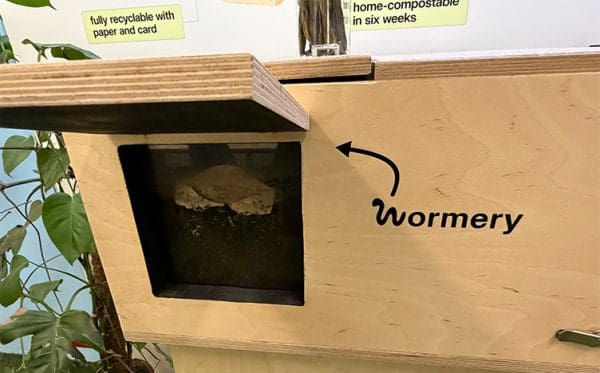
With coated paperboard, we must also consider how our materials affect the recycling of the complete pack. The coatings cannot compromise the overall packaging recyclability and do not require any additional conditions or different waste streams to be recycled. We have obtained recyclability certifications for our coated food containers, including versions with a film window.
The coating accounts for around 3% of the overall packaging weight, rising to around 5% with the film included. Those proportions have allowed the packaging we have tested to meet the relevant recyclability criteria and stay recyclable in traditional cardboard waste streams.
Mel: We consider other elements of the finished packaging too. For example, we work with partners to minimise ink coverage, so that branding does not undermine the recyclability or compostability we are trying to achieve. So we really do take the effort to fully understand the application and apply our principles across the whole process.
Will: What support can a manufacturer expect beyond the supply of material?
Conor: Being hands-on is important. We can attend trials and help select a grade according to the application and the performance needed. We want to understand the problem a manufacturer or their customer is trying to solve, because that allows us to judge whether we have a suitable material now, whether development is needed, or whether it is not a feasible application.
We also introduce brand owners to manufacturing partners. As a relationship develops, we can pass on leads and opportunities for the manufacturer to take forward, while continuing to support the project where we can add value.
Mel: We also work across the value chain to help generate demand. That includes working with manufacturers and brands, but also communicating with consumers who influence what brands ask for.
There is a commercial side to introducing a new material. A manufacturer needs a customer who wants to use it, and a brand needs a manufacturer capable of making the product. We spend a lot of time developing those relationships and helping partners communicate the work they are doing.
Will: What developments are you working on next?
Conor: On the pellet side, we have been expanding our natural masterbatch capabilities and working with partners on more bespoke colours and finishes. There are limits: our base material is a light brown, so it is easier to go darker than lighter, so we cannot offer a clear or white material, but this is an area we’re actively researching and developing. We are also working with branding features such as embossing and debossing on moulded parts.
In coatings, a major focus is improving the water barrier for applications such as coffee cups. Our existing foodservice coating is suitable for hot and cold foods, but it is not suitable for holding liquids such as soup or coffee. We’ll hopefully have some exciting developments to announce in this area soon.
We are also part of a three-year Horizon Europe project developing the next generation of coatings for these applications. There is also work on other applications, including frozen food packaging.
Mel: We are constantly developing both the applications and the materials. We want to increase the use of products that are already viable at scale, while continuing to improve formulations and investigate where else they could work. That might mean better moisture resistance, a different application method or another use for the pellets or coatings.
Will: Where can manufacturers meet the team and explore these opportunities?
Mel: We are hosting a roundtable event at the Royal Academy of Engineering in London on 27 November. It will bring together manufacturers, brand owners and others working in this area to discuss opportunities for natural polymers.
The speakers will include people with decades of experience in the polymer and plastics industry, alongside brand representatives who have already introduced material innovation into their products or packaging. There will be opportunities for wider discussion and networking, so it will be useful for any manufacturers who want to understand where they could get involved.
Will: What would you say to a manufacturer with an idea for an application but no experience of processing your materials?
Conor: Get in touch and explain what you or your customer want to achieve. Having that understanding at the start helps us identify the right approach and whether it is something we can address now or through a development project.
We really value the technical expertise within UK manufacturing. Many of the breakthroughs we have made have come through working with those partners, and we want to build more of those relationships. Having another material option could help a manufacturer offer something different to a customer or approach a market they have not supplied before.
Mel: If a manufacturer has a brief from a brand and is unsure how to tackle it, that is a useful conversation to have with us. It may become a development project rather than an off-the-shelf solution, but we are open to exploring what could be possible.
Considering the next application
The visit gave us a much clearer view of the work behind Notpla’s products. For a moulder considering a trial, the team’s willingness to discuss tooling, properties and the limits of individual grades is useful. It provides a starting point for assessing a real customer brief and the team indicated a real desire to experiment and to prove the viability of its material in a range of applications.
Manufacturers interested in discussing an idea, a potential project or want to find out more about the 27 November roundtable event, you can find more information and sign up here.
Thank you to Conor, Mel and Callum for another fascinating visit!
Read more news about Notpla here.