WITTMANN Group at Fakuma 2026: Precision Meets Efficiency
 Jess Clarke
- 6 minutes read

|
Getting your Trinity Audio player ready...
|
All-electric efficiency will be one of the WITTMANN Group’s highlights at the Fakuma 2026 from 12 to 16 October in Friedrichshafen, Germany. Three live machine exhibits will demonstrate clearly how lots of energy, material, time and space can be saved in a wide variety of applications with all-electric injection moulding machines and fully automatic processes. Smart Choices, Smart Savings – this is WITTMANN’s motto at the Fakuma 2026 in hall B1.
Focusing on essentials – for greater profitability
The new all-electric EcoPrimus injection moulding machine from WITTMANN combines performance, precision and reliability with outstanding cost-efficiency in producing large quantities. It will prove this at Fakuma 2026 by making protective caps for insulin pens inside an 8-cavity mould supplied by Kistler. For fully automatic production with a very compact footprint, this machine comes equipped with intelligent assistance and a FlexCell plus automation cell.
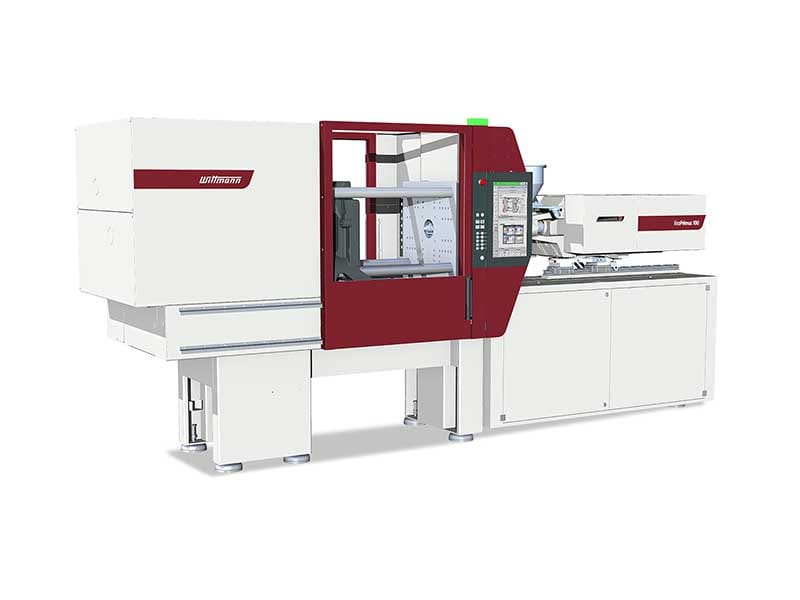
At WITTMANN, the designation Primus stands for a clear focus on essentials – with the highest possible material, energy and cost efficiency, without compromising on output, quality standards or spare parts availability. To this end, the EcoPrimus with 1000 kN clamping force was specially developed for compact single-component injection moulding requiring only a limited range of options. It reaches injection speeds of up to 200 mm/s and operates with the latest-generation B8X control system from WITTMANN.
The all-electric design principle of the EcoPrimus is based on the company’s long-standing experience with the proven EcoPower machine series. Both series stand for high precision, repeatability and energy efficiency, and offer full Wittmann 4.0 compatibility. The EcoPrimus to be shown at Fakuma comes equipped with the HiQ Packing digital assistance system for autonomous process optimisation. This software enables extremely precise control of the screw movement at the changeover point and during the holding pressure phase, and ensures well-balanced pressure distribution plus even cavity filling right up to the marginal areas of the mould parting line. This results in the reliable production of consistently high-quality parts when using multi-cavity moulds.
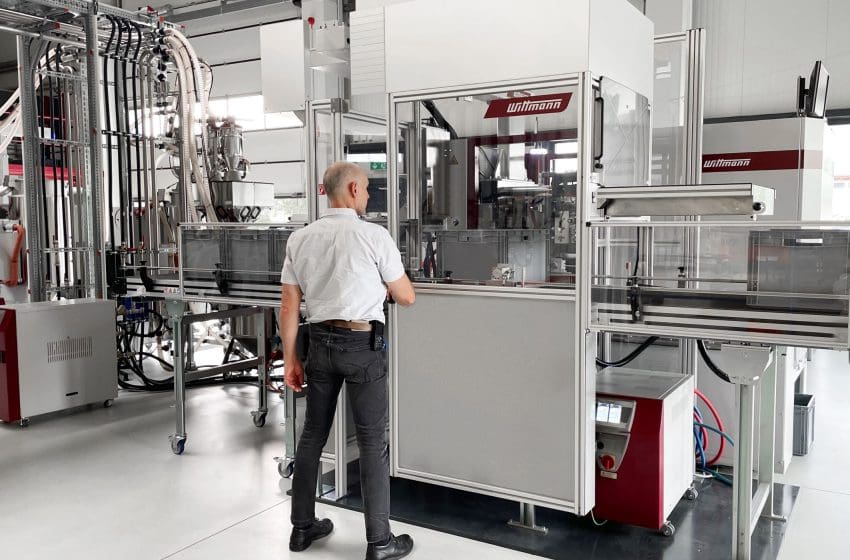
The FlexCell plus makes a further contribution to the extremely high overall efficiency of the application. The automation cells in the FlexCell series are based on a standardised modular design, combining top-level cost efficiency with flexibility. A WITTMANN linear robot, a conveyor belt and further individually selectable automation components can all be accommodated within an extremely compact floor space. Since the cells are directly connected to the injection moulding machine and allow production with the machine guard door kept open, the automation system can be positioned very close to the mould. Positive side effects include reduced handling times and lower investment costs, since a shorter Z-axis is sufficient for the robot.
In the plus version to be shown at Fakuma, the FlexCell incorporates a fully automated box transfer system for directly packaging injection-moulded parts into crates, KLTs or cardboard boxes, with the goal of producing autonomously for several hours. The parts removed from the mould by the robot can be deposited either at random or according to a set stacking pattern. The special feature is the integration of the box transfer system and protective housing into a fixed unit, which can easily be pushed to one side as a whole to provide access to the mould space at any time.
The FlexCell automation cells are compatible with injection moulding machines of all brands and can be retrofitted to existing production equipment.
Micro injection moulding: complete production cell within 2 m²
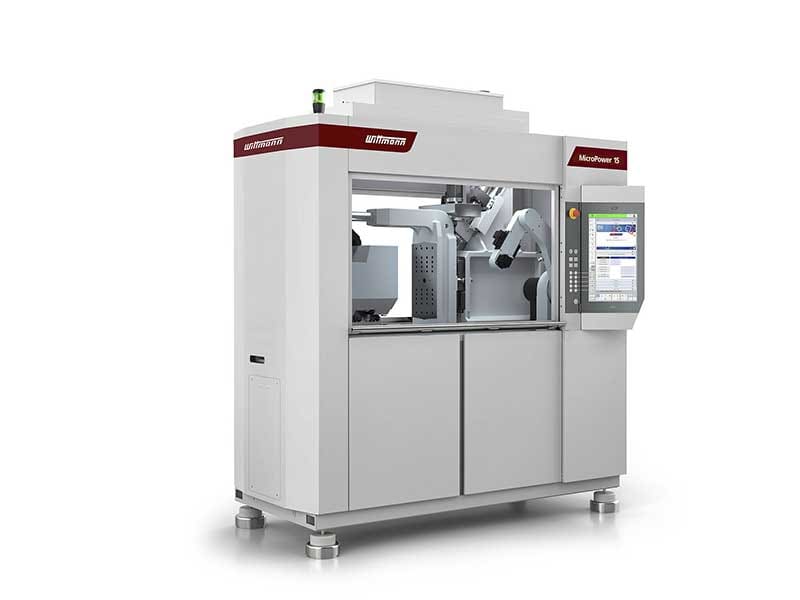
Lab-on-a-chip means that complete laboratory processes can be integrated onto a chip only a few square centimetres in size, for instance for quick, mobile point-of-care diagnostics in emergency medicine. Here, an exciting aspect from the point of view of injection moulding is microfluidics. The sample to be examined and the diagnostic fluids flow through extremely narrow channels only a few micrometres in diameter.
In this highly sensitive field of application, the MicroPower from WITTMANN plays to its strengths. This all-electric injection moulding machine, specially designed for moulding micro and nano parts with shot weights ranging from 0.05 to 4 grams, ensures the high-precision forming of extremely fine structures down to the nanometre range. The channels of the lab-on-a-chip sample parts made from transparent polypropylene to be produced at Fakuma 2026 have diameters of no more than 0.04 mm and corner radii down to 0.005 mm. During the five days of the fair, the MicroPower 15/10 will operate with 3D-printed 2-cavity mould inserts from NanoVoxel inside a basic mould box supplied by Ernst Wittner.
The MicroPower’s special feature is its extremely compact design. Within only 2 m², the machine concept integrates a rotary table, auxiliary equipment, automation, temperature control, quality inspection and further process units. For demanding cleanroom applications, the production cell can be very easily encapsulated by a laminar flow box.
The machine’s design supports material-saving operation, since the injection plunger reaches right down to the mould parting line. In this way, the melt cushion is reduced to a minimum and the sprue is significantly reduced, if not eliminated altogether. A positive side effect is greater consistency in quality standards, since pressure transmission takes place via an extremely short flow path. The MicroPower requires no special micro-granulates. It can process all standard granulates.
LSR: ultimate precision and energy efficiency
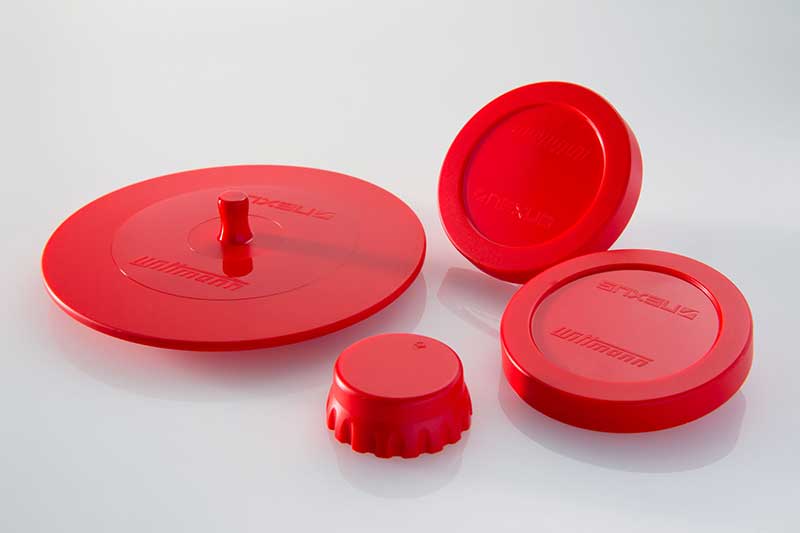
The all-electric EcoPower is at home wherever precision, efficiency and cleanliness are essential. It delivers high injection speeds, extremely precise regulation and great dynamism. Direct servo drives and the utilisation of deceleration energy reduce energy consumption to a minimum. Thanks to its modular design, the EcoPower adapts flexibly to a vast range of different production requirements.
Liquid silicone processing benefits from this combination of characteristics. Together with its partner Nexus Elastomer Systems, WITTMANN will demonstrate the production of silicone lids for covering beverage cans, bottles and cups at the Nexus stand in Hall A6 (stand No. 6222). The equipment used for this purpose will be an EcoPower 110/350 B8X in LSR version with a 4-cavity mould and a W918 linear robot from WITTMANN. For material feeding, a ServoMix X200 dosing system has been integrated into the work cell. The ServoMix X200 is an extremely flexible LSR dosing system that combines high throughput with precision and material efficiency.
WITTMANN at Fakuma 2026: Hall B1, stand 1204
Read more news from Wittmann Group.

Wittmann Group
01933 275777
Website
Email