Injection Moulding Headaches Part 10: Splay (and How to Fix It) // Alliance Tooling Blog
 Jess Clarke
- 3 minutes read

|
Getting your Trinity Audio player ready...
|
Here’s another defect that’s often mistaken for silver streaks…splay.
This is the tenth instalment in Alliance Tooling’s weekly series, where the company explores common moulding defects and the practical steps that can prevent them through better design, tooling, and process control. This week’s issue is splay.
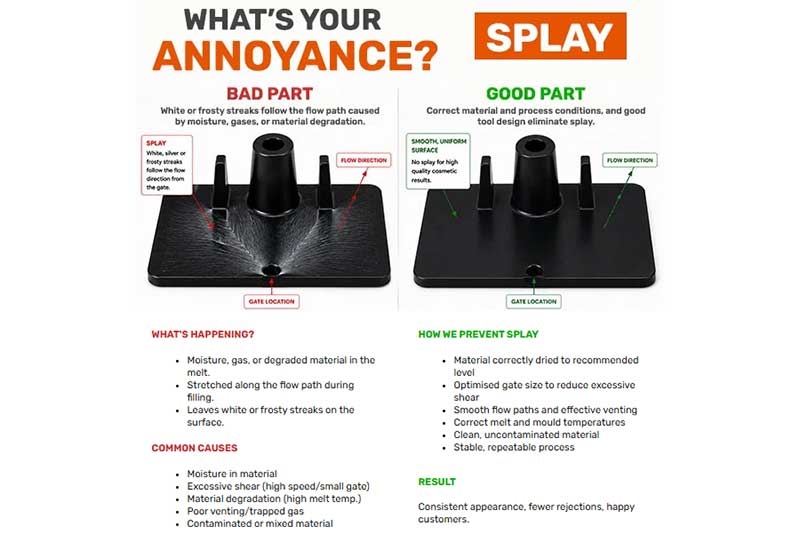
Splay appears as white, silver or frosty streaks that follow the direction of material flow across the surface of a moulded part.
At first glance, it looks very similar to silver streaks, but the cause is often quite different.
Splay can:
- Ruin the cosmetic appearance of parts
- Increase rejection rates
- Reduce customer confidence
- Indicate poor material condition or excessive shear
- Reduce customer confidence in product quality
Why does splay happen?
Splay is caused when moisture, volatile gases or degraded material are stretched through the melt during injection.
As the material flows through the cavity, these gases are dragged along the flow path, leaving visible streaks on the finished part.
Common causes include:
- Insufficient drying of hygroscopic materials
- Material degradation from excessive melt temperature
- Excessive shear through small gates or thin runners
- Contaminated or mixed material
- Trapped gas caused by poor venting
How to design it out (before tooling even starts)
Although material preparation plays a major role, good tool design helps minimise the conditions that create splay.
At Alliance Tooling, we focus on:
- Designing gates that minimise excessive shear
- Incorporating effective venting to release trapped gases
- Creating smooth flow paths with minimal restriction
- Matching gate design to the selected polymer
- Designing tooling for stable, repeatable processing
Already seeing splay? Here’s how to fix it
If splay is appearing in production, several adjustments can often eliminate it:
- Dry the material to the manufacturer’s recommended moisture level
- Reduce the melt temperature if degradation is suspected
- Reduce injection speed if excessive shear is occurring
- Increase gate size where appropriate
- Improve venting within the mould
- Eliminate contaminated or degraded material from the process
If the issue persists, a review of the gate design or tooling may be required.
Where we come in
Splay isn’t always a tooling problem, but good tooling makes it far easier to produce consistent, high-quality parts.
At Alliance Tooling, we:
- Assess both the mould and the moulding process
- Design tools that promote smooth material flow
- Help customers eliminate cosmetic defects before they become production headaches
Whether it’s:
- A new mould tool
- Troubleshooting an existing mould
- Or improving cosmetic quality
We’ll help identify the real cause and provide a practical solution.
Seeing splay or struggling to achieve a consistent surface finish? Book a quick call with Chris Rossell, Technical Director, and we can review it with you.
Read more news from Alliance Tooling here.

Alliance Tooling
+44(0)116 275 0584
Website
Email