Injection Moulding Headaches Part 11: Gate Blush (and How to Prevent It) // Alliance Tooling Blog
 PlastikMedia Guest
- 3 minutes read

|
Getting your Trinity Audio player ready...
|
For the eleventh instalment in Alliance Tooling’s weekly series, gate blush and preventative steps are covered.
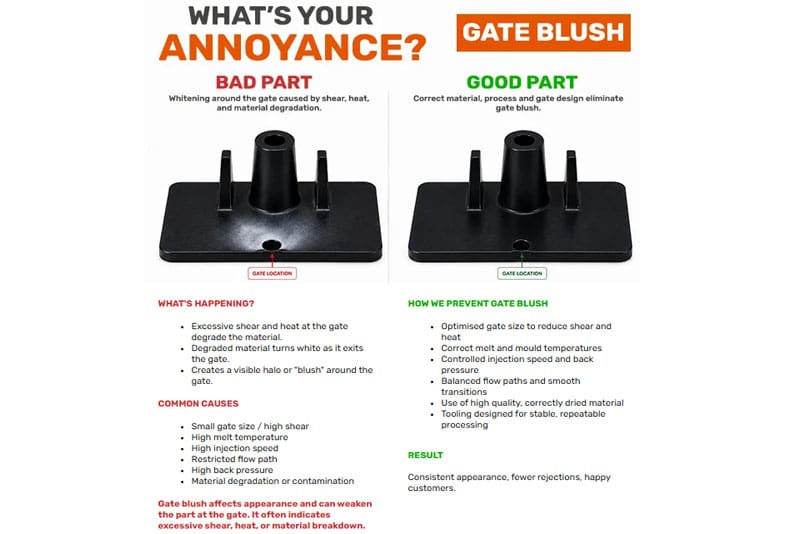
Gate blush is the cloudy, hazy or discoloured area that appears around the gate of an injection moulded part. Unlike silver streaks or splay, which can travel across the component, gate blush is normally concentrated at or immediately downstream of the gate.
It can:
- Ruin the cosmetic appearance of a component
- Make the gate area much more noticeable
- Reduce customer confidence
- Increase rejection rates on appearance-critical parts
- Indicate excessive shear or stress as material enters the cavity
Why does gate blush happen?
Gate blush is commonly caused by the molten plastic experiencing excessive shear as it passes through the gate and rapidly enters the cavity. If the gate is too restrictive, or the initial injection speed is too high, the material can be subjected to high shear rates and localised heating.
Common causes include:
- Gate size being too small
- Excessive initial injection speed
- Poor gate geometry
- Restrictive flow immediately after the gate
- Incorrect melt or mould temperature
- Material being particularly sensitive to shear
How to design it out (before tooling even starts)
This is where good gate design becomes critical.
At Alliance Tooling, we focus on:
- Selecting the correct gate type and size
- positioning the gate to promote smooth material flow
- Avoiding unnecessary restrictions immediately after the gate
- Designing smooth transitions into the cavity
- Considering the flow and shear characteristics of the chosen material
The objective is simple: get the material into the cavity smoothly, rather than forcing it through an unnecessarily restrictive gate.
Already seeing gate blush? Here’s how to fix it
If gate blush is appearing during production, there are several things to investigate:
- Reduce the initial injection speed as material passes through the gate
- Increase gate size where appropriate
- Review gate geometry and entry into the cavity
- Optimise melt and mould temperatures
- Check material condition and drying requirements
- Use a profiled injection speed to control the initial filing phase
Sometimes a relatively small change to the gate can make a significant difference to the finished component.
Where we come in
Gate blush is a good example of why the smallest details in a mould tool can have a big effect on the finished part.
At Alliance Tooling, we:
- Design gates around the component and material
- Consider how the polymer will actually enter and fill the cavity
- Optimise tooling to create a stable processing window
- Help troubleshoot existing tools where gate-related defects are causing problems
Whether it’s:
- A new mould tool
- An existing component with cosmetic issues
- Or a process that’s proving difficult to stabilise
We look beyond the visible defect to understand what’s actually causing it.
Read more news from Alliance Tooling here.

Alliance Tooling
+44(0)116 275 0584
Website
Email