LATI Recycled Engineering Thermoplastic Cuts Carbon Footprint in Structural Blind Application
 George Nowill
- 4 minutes read

|
Getting your Trinity Audio player ready...
|
Reducing the carbon footprint of engineering thermoplastics without compromising component performance is one of the key challenges for the injection moulding industry. This project developed by Crossen Engineering, Bloc Blinds and LATI demonstrates how a compound based on a polymer matrix obtained from chemical recycling can also be used in structural applications subject to reliability and durability requirements.
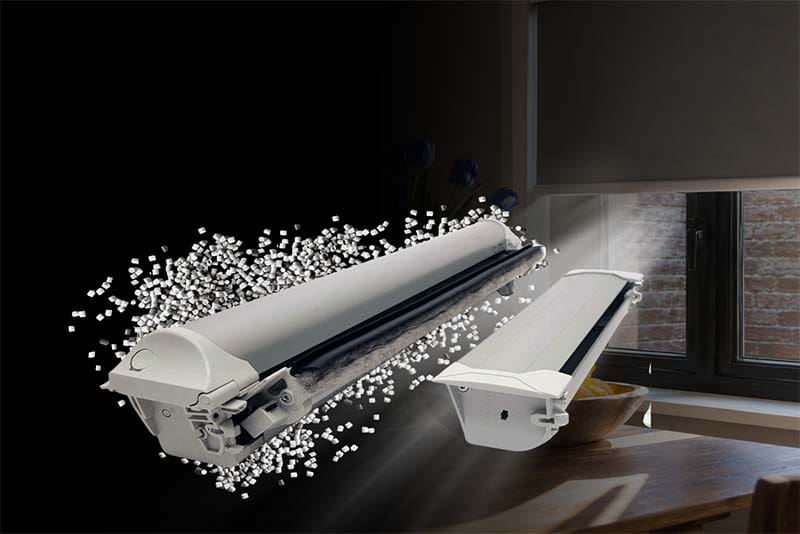
The application concerns the structural components of a new prototype motorised blackout blind developed by Bloc Blinds, a British company specialising in made-to-measure roller blinds for
residential and commercial applications.
With the technical and manufacturing support of Crossen Engineering, the project assessed the replacement of a traditional fossil-based compound with LATIECO 62 CR G/30, a PA6 polyamide
reinforced with 30% glass fibre, developed by LATI using a polymer matrix derived entirely from chemical recycling.
In chemical recycling, the polymer chains of the materials to be recovered are broken down to obtain monomers, which are then subjected to a new polymerisation process. This approach makes it possible to produce a new polymer matrix with chemical and physical characteristics comparable to those of conventional materials, limiting the effects of the recovery process on the final performance of the compound.
Reducing Material Carbon Footprint by Around 70%
The main benefit lies in the reduction of the material’s carbon footprint. For LATIECO 62 CR G/30, the indicated Global Warming Potential (GWP) decreases from approximately 5.5–6 kg CO₂
eq./kg for the corresponding traditional fossil-based product to approximately 1.5–2 kg CO₂ eq./kg for the solution based on the chemically recycled matrix. This comparison highlights a reduction of around 70%, which may exceed this threshold depending on the values considered.
However, the objective of the project was not limited to reducing environmental impact. Crossen Engineering and Bloc Blinds verified that the material was able to meet the mechanical, dimensional and functional requirements of the structural components of the new motorised blind.
The compound was therefore subjected to a validation programme including functional tests and durability testing carried out directly on the system. Tests performed by Bloc Blinds showed
performance comparable to that of the conventional fossil-based compound under the expected test conditions.
The validation included more than one thousand operating cycles, successfully completed by components made from LATIECO 62 CR G/30. This result confirms the suitability of the material
for applications where reliability, structural stability and repeatable operation are essential requirements.
“This project demonstrates the value of a collaboration based on complementary expertise. Bloc Blinds defined the application requirements and carried out functional testing on the system, Crossen Engineering supported the design and manufacturing evaluation of the components, while LATI provided the compound and its materials expertise. The joint work made it possible to
validate the solution not only through technical data, but directly on the component and throughout its operating cycle,” said Ben Hargreaves, Sales Area Manager – UK & Ireland.
Moving Recycled Materials Into More Demanding Applications
The application case highlights how engineering thermoplastics derived from chemical recycling can also be considered for injection-moulded structural components, moving beyond the idea that
recycled raw materials must necessarily be limited to less demanding applications.
The possibility of integrating a chemically recycled polymer matrix into a reinforced compound makes it possible to address two design requirements at the same time: reducing the environmental impact associated with the material and preserving the characteristics required for the final product to function correctly.
“Chemical recycling expands the possibilities for using recycled raw materials in engineering thermoplastics intended for structural components. In this project, validation on the component
showed that it is possible to substantially reduce the Global Warming Potential of the compound while maintaining the mechanical performance and durability required by the application. The result comes from the integration of material design, injection moulding process evaluation and functional validation of the final product,” commented Luca Posca, Group Technical Assistance & Marketing Director at LATI.
“LATI has supported us as a materials supplier for over 15 years, and this project was a great showcase of that partnership. We’re proud to have helped Bloc Blinds prove that recycled engineering plastics can meet the same demanding standards as fossil-based materials, without compromise.” said Crossen Engineering Business Development Manager Peter Crossen.
Collaboration Across The Injection Moulding Value Chain
The collaboration between LATI, Crossen Engineering and Bloc Blinds therefore confirms the role of joint design across the value chain. Material selection, component optimisation, the injection
moulding process and application validation must be considered as parts of a single development path, especially when environmental targets need to be achieved without reducing product reliability.
The project represents a concrete example of how circular economy principles can be applied to the injection moulding of technical components, demonstrating how carbon footprint reduction can
be supported by quantitative data and tests carried out on the real product.

LATI
+44 (0) 1270 501713
Website
Email