Injection Moulding Headaches Part 6: Jetting (and How to Fix It) // Alliance Tooling
 PlastikMedia Guest
- 2 minutes read

|
Getting your Trinity Audio player ready...
|
Here’s another defect that can quickly ruin the appearance of an otherwise good moulding. This week’s issue is jetting.
This is the sixth instalment in Alliance Tooling’s weekly series, where the company break down common moulding problems and looks at how to prevent them through better tooling and process decisions.
The Problem: Jetting
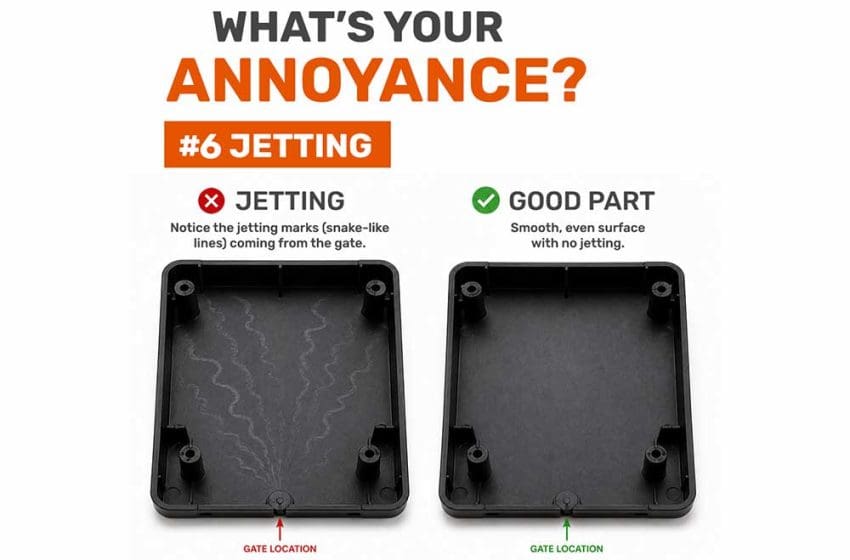
Jetting shows up as snake-like flow lines or squiggle marks on the surface of a moulded part.
It occurs when molten plastic enters the cavity too quickly and solidifies before it has a chance to properly fuse with the surrounding material.
The result is often a visible surface defect, and in some cases, a reduction in part integrity.
Jetting can:
- Ruin cosmetic finishes
- Create weak areas within the part
- Lead to inconsistent surface quality
- Cause customer complaints or rejected components
Why does jetting happen?
Jetting usually occurs when molten material enters the cavity at high speed without contacting the mould wall properly.
Instead of flowing smoothly, the material “jets” forward like a stream.
Common causes include:
- Excessive injection speed
- Small or poorly positioned gates
- Low mould temperatures
- Thin-wall sections near the gate
- Poor flow path design
How to design it out (before tooling even starts)
Gate design and flow control play a major role in preventing jetting.
At Alliance Tooling, we focus on:
- Positioning gates to encourage smooth, controlled flow
- Designing runners and gates for balanced filling
- Avoiding direct jetting into open cavity areas
- Optimising wall thickness transitions
- Designing around material flow behaviour
Already seeing jetting? Here’s how to fix it
If jetting is already appearing in production, there are several ways to improve it:
- Reduce injection speed during initial fill
- Increase mould temperature
- Modify gate size or location
- Improve flow direction into the cavity wall
- Adjust processing parameters to promote smoother filling
- In some cases, tool modifications may be required
Where Alliance Tooling come in

Jetting is often mistaken for “just a processing issue” – but the root cause is frequently linked to gate and tooling design.
At Alliance Tooling, we:
- Identify why the material is flowing incorrectly
- Design tools for stable, repeatable filling
- Help eliminate cosmetic and structural defects at the source
Read more news from Alliance Tooling here.

+44(0)116 275 0584
Website
Email