Extrusion: Why Do Screws Wear Faster Than Expected? // Bausano Blog
 PlastikMedia Guest
- 2 minutes read

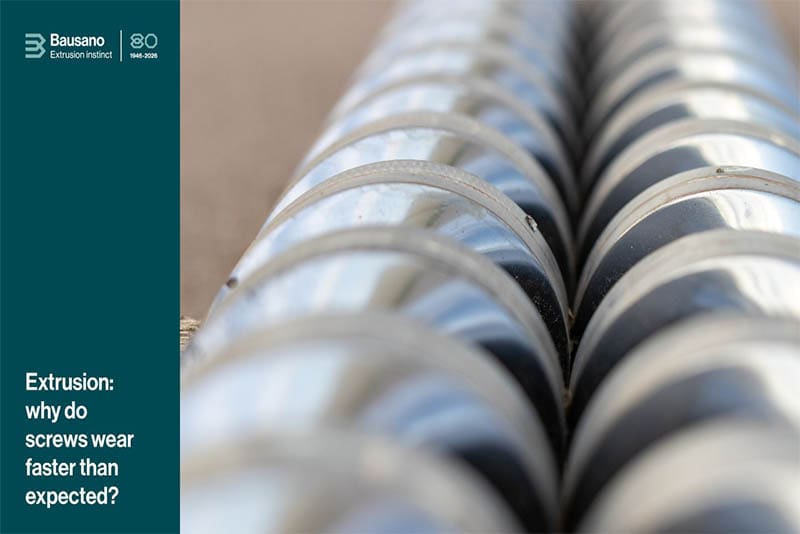
Among the topics most often discussed in the world of extrusion, one concerns screw durability. It is a delicate subject because, when a screw or screw segment wears out faster than expected, the consequences affect production continuity, product quality and maintenance costs.
Bausano discusses the question that arises in production, which is always the same: why did it happen?
Wear almost always results from the interaction between the processed material, formulation, screw configuration and operating conditions.
Many formulations contain mineral fillers, fibres, calcium carbonate, talc, silica or other fillers that increase abrasive action.
But not all wear is the same. In some cases, it is progressive abrasion. In others, the wear-resistant coating loses adhesion or begins to delaminate.
The Most Common Signs Are:
• Oscillations in extrusion pressure
• Black spots or metallic contamination
• Reduction in output
• Increase in absorbed torque
• Greater product quality instability
In these cases, modifying temperature or screw speed may reduce the symptom, but rarely eliminates the cause.
For a correct diagnosis, it is necessary to understand what type of wear is being observed and to analyse formulation, screw and process conditions before identifying the most suitable solution.
At Bausano, the starting point is always this analysis, because understanding why a screw has worn out earlier than expected is the first step towards reducing machine downtime, premature replacements and production instability.
To explore these aspects in greater depth, Bausano is available for a technical discussion.

Bausano
+44 (0) 7815 921 951
Website
Email