Why Do Industrial Cooling Systems Fail in Spring? // Refcool Blog
 PlastikMedia Guest
- 5 minutes read

|
Getting your Trinity Audio player ready...
|
Over the past few weeks, Refcool has seen a clear pattern across multiple sites. Cooling systems that have run all winter quietly are now starting to struggle as demand and temperatures increase.
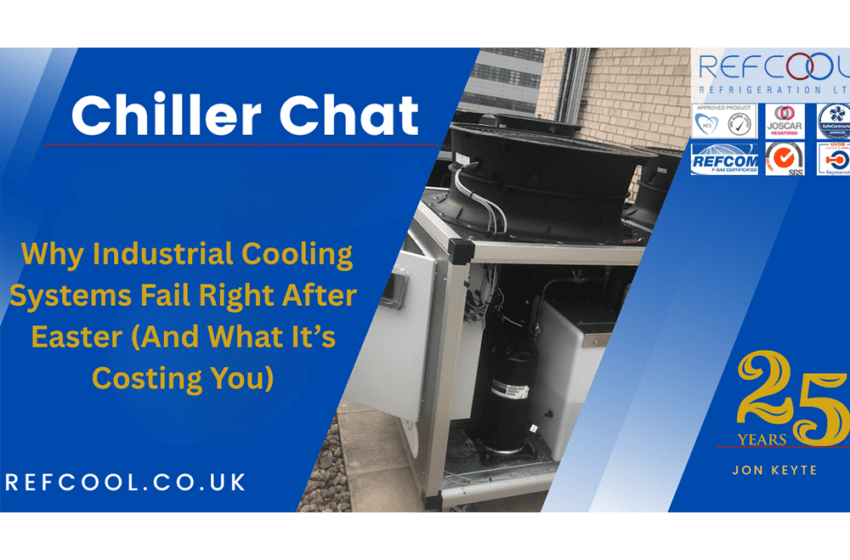
In this edition of Chiller Chat, Jon Keyte, Director at Refcool UK, wants to share what he is seeing on the ground, why systems often fail just after Easter, and what you can do now to avoid disruption later in the year.
Refcool designs, installs, and supports industrial cooling systems across the UK, particularly in environments where performance, reliability, and efficiency are critical.
Are You Seeing These Cooling Challenges?
Across manufacturing, food and drink, healthcare, breweries, and other high‑demand environments, cooling is not a support system. It is a production dependency.
We are increasingly being called in where sites are dealing with:
- Frequent production stoppages
- Rising or unpredictable energy consumption
- Increasing ambient temperatures
- Outdated or undersized equipment
- Space constraints around the existing plant
When cooling fails, it does not begin with a technical discussion.
It begins with pressure.
“How long are we down?” “How quickly can you fix it?” “What is this going to cost us?”
Why Does This Happen Now?
Most systems have not been tested under real operating conditions for months.
- Lower winter temperatures reduce system strain
- Reduced demand masks inefficiencies
- Minor faults remain hidden
Then spring arrives.
Demand increases. Ambient temperatures rise. The system is finally pushed.
That is when the weaknesses appear.
A.R.E. You Ready for Summer?
Are you aware of the risks and your system’s efficiency before it fails?
A. Awareness
What should you be spotting right now?
- Restricted airflow around condenser coils
- Inconsistent water flow or blocked strainers
- Pallets, stock, or equipment creeping into airflow zones
- Coils fouled with dust, paper debris, or production waste
- Systems that have not been stress‑tested since winter
- Units located in corners or tight spaces with limited ventilation
Even small restrictions can reduce performance far more than most people expect.
R. Risk
What happens if nothing changes?
As temperatures and demand increase:
- System pressures rise
- Compressors are forced to work harder
- Cooling capacity drops at the worst possible moment
- Heat rejection becomes less effective
This is where pressure spreads across the business.
- Production slows or stops
- Delivery timelines slip
- Staff remain on shift but cannot operate
One of the biggest hidden risks we see is running with a standby unit that is assumed to work but has not been tested properly.
It feels like backup. It usually is not.
E. Efficiency
Where performance is quietly lost
Efficiency is not just about energy usage. It is about how well your system performs when you actually need it.
We commonly see efficiency lost through:
- Dirty coils are increasing system pressure
- Blocked airflow reduces heat rejection
- Increased demand with no system upgrade
- Equipment operating outside its original design capacity
A well‑performing system should have:
- Capacity aligned with current demand
- Clean heat exchange surfaces
- Stable, continuous operation
- Clear airflow around the unit
What We Are Seeing Right Now
Across multiple sites:
- Airflow is restricted by pallets, stock, or layout changes
- Cooling systems are installed to fit the space rather than for performance
- Units placed behind equipment or unintentionally used as storage zones
- Increased production demand with no increase in cooling capacity
The system has not suddenly failed.
It has been gradually restricted, stressed, and outgrown.
The Cost of Waiting
“We’ll deal with it later” often works. Until it doesn’t.
When failures happen under pressure:
- Downtime is immediate
- Decisions become reactive
- Costs escalate quickly
In most cases, the highest cost is not the repair itself. It is everything around it.
For many production environments, a single day of downtime can mean:
- Orders delayed or lost
- Production targets missed
- Staff are paid but unable to operate
- Pressure is building across operations and leadership
It is common for the combined impact to reach tens of thousands of pounds per day.
The longer it runs unresolved, the fewer options you have.
What could have been planned becomes urgent. What could have been optimised becomes reactive.
Most businesses do not feel the cost in the repair. They feel it in the hours before and after it.
Five Questions to Ask Your Team This Week
Whether you work in operations, engineering, or estates, these are worth reviewing now:
- Are our condenser coils clean, or are they restricting heat rejection?
- Has production demand increased since the system was installed?
- If this system failed tomorrow, do we know the real cost of downtime?
- Is our standby system fully operational and tested, or are we assuming it will work?
- Do we have clear airflow around our cooling system, or has the area become a storage space?
A Simple Next Step
If any of this felt familiar, it is worth taking a closer look now while you still have time and options.
No heavy process. Just a practical conversation to sense‑check:
- Where your system is today
- What risks may be sitting underneath
- What, if anything, needs attention before demand peaks
If you want a second set of eyes on it, you can:
- Book a Chiller Chat (30 minutes, no pressure)
- Request the Refcool checklist
- Or reply and outline what you are seeing
Behind the Scenes at Refcool
Refcool is a family‑run engineering business based in Devon.
Over the past year, Rowan has joined the team and is spending increasing time across sites, seeing first‑hand where cooling systems struggle under real operating conditions.
He has started sharing these observations on LinkedIn, highlighting patterns we are seeing across manufacturing and OEM environments.
If that would be useful, feel free to connect and follow along.
One Final Thought
Most systems do not fail in summer. They fail because no one prepared for the summer.
Cool Solutions. Warm Results.
Read more news on Refcool here.

Refcool Refrigeration
01489797100
Website
Email