Refcool Releases 2026 F Gas Update for UK Manufacturers
 Dan Russell
- 6 minutes read

|
Getting your Trinity Audio player ready...
|
Refcool is a family-run engineering business specialising in chillers for challenging locations and bespoke applications. Alongside design and installation, its engineers support clients across the UK with service, diagnostics, optimisation, and energy audits.
If you want to discuss a project, replacement cycle, or potential compliance risk, you can book a Chiller Chat session via the Refcool website.
This issue focuses on the 2026 F Gas regulatory direction and what it now means for refrigerant selection in chillers and heat pumps.
In February 2025, Refcool published its original Countdown to 2027 F Gas update, outlining the regulatory changes approaching industrial cooling.
Since then, the regulatory direction has hardened, and the practical implications for sites have become clearer. This 2026 update reflects where the industry now sits.
Industry update
Navigating F Gas regulations and refrigerant choices in 2026
Across Europe, the regulatory direction is now clear under EU Regulation 2024/573. While the UK has not yet fully incorporated this into domestic law, industry planning during 2026 is increasingly based on expected UK alignment.
What Refcool is now seeing across food and drink manufacturing, plastics processing, defence environments, and OEM-led industrial sites is less debate about whether change is coming, and more pressure around how to implement it in real operating conditions.
Space-constrained plant rooms, indoor installations, and process-critical cooling are where the challenges are now concentrating.
Key changes being planned include:
- Small chillers under 12 kW Ban on refrigerants with GWP 150 or above
- Large chillers over 12 kW Ban on refrigerants with GWP 750 or above
- Self-contained heat pumps up to 50 kW Generally more restrictive, often requiring GWP below 150
Exemptions may apply where installation site safety requirements prevent the use of low GWP refrigerants.
Impact on small chillers under 12 kW
This is where many sites are likely to experience the sharpest shift during 2026.
Most refrigerants with a GWP below 150 fall into A2L or A3 classifications, meaning mild to high flammability.
In practice, this can introduce:
- Ventilation and extraction requirements
- Leak detection requirements
- Constraints on indoor installation
- In some cases, the need to locate equipment outdoors or within controlled plant areas
For many smaller process chillers used in OEM equipment, laboratories, production lines, and indoor plant areas, this is where late-stage compliance can become disruptive.
Layout changes, temporary solutions, or higher cost compromises are more likely when decisions are delayed.
Non flammable low GWP options
CO₂ and ammonia
Two natural refrigerants avoid flammability concerns but bring different design and safety considerations.
R744 CO₂
High operating pressures | Oxygen displacement risk | Indoor installation requires appropriate ventilation and detection
R717 ammonia
Strong efficiency potential | High toxicity | Indoor installation requires robust containment, alarms, ventilation, and access control
These refrigerants can be highly effective solutions when engineered correctly, particularly in larger or dedicated plant environments, but they are rarely simple replacements for compact indoor systems.
Larger chillers over 12 kW
With a GWP limit of 750, a broader selection of refrigerants becomes available, including non-flammable options.
R513A is often considered because it offers:
A1 safety classification | GWP around 630 | A performance profile similar to R134a in many applications
R513A is a blend containing R134a and R1234yf, which leads to a growing conversation around HFO lifecycle impacts.
Emerging concerns about HFOs
HFOs were introduced as lower GWP alternatives, but increasing evidence highlights longer-term considerations that are now influencing refrigerant strategy decisions:
- Breakdown into TFA, a persistent PFAS compound
- Potential formation of higher GWP gases during atmospheric breakdown
- Manufacturing pathways involving ozone impacting feedstocks
- Environmental accumulation of TFA in water sources
- Rising regulatory interest globally
For operators planning equipment with a long service life, this reinforces the importance of considering not just current compliance, but future regulation, refrigerant availability, and environmental scrutiny over the next decade.
Refcool IP New Gen chillers using lower GWP refrigerants
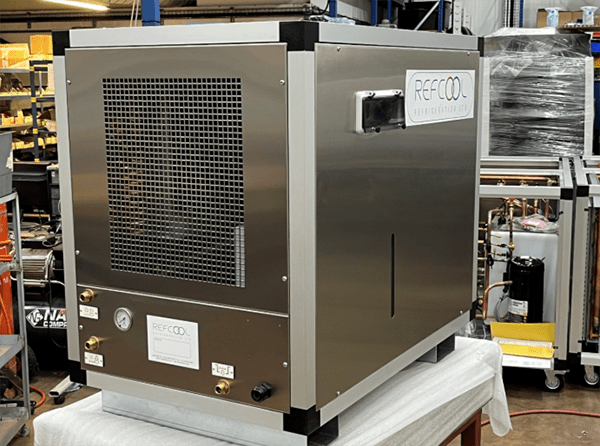
As regulations tighten and refrigerant availability evolves, Refcool offers IP New Gen chillers using lower GWP refrigerants such as R454B.
These systems are designed for sites that need to balance regulatory compliance with indoor safety requirements, energy efficiency, and long-term serviceability, particularly within OEM machinery and process cooling environments.
R454B highlights
- GWP 466 compared with R410A at 2088
- Strong efficiency potential for reduced operating cost
- Suitable for many medium-sized process cooling applications
Example products:
- IP New Gen 201 https://www.refcool.co.uk/shop/product/2149123000034914106
- IP New Gen 401 https://www.refcool.co.uk/shop/product/2149123000041043213
- IP New Gen 702 https://www.refcool.co.uk/shop/product/2149123000041043273
F Gas 2026: Questions Being Asked, and Refcool’s View
1. What exactly are F Gases?
Refcool insight: F Gases are fluorinated greenhouse gases commonly used as refrigerants in cooling and heating systems. Many traditional refrigerants fall into this category and are now being targeted due to their high Global Warming Potential.
2. What does GWP actually mean in practice?
Refcool insight: GWP stands for Global Warming Potential. It measures how much heat a gas traps in the atmosphere compared to CO₂. Lower GWP refrigerants reduce environmental impact, but they often introduce new safety, design, or operational considerations.
3. What is actually changing in 2026?
Refcool insight: The direction of travel is toward lower allowable GWP in new equipment, with thresholds depending on chiller size and heat pump type. While UK legislation is still evolving, most responsible planning during 2026 assumes alignment with EU Regulation 2024/573.
4. Do these rules affect existing chillers?
Refcool insight: In most cases, the restrictions apply to placing new equipment on the market. Existing chillers can continue to operate. However, servicing limitations, refrigerant availability, and rising costs often become the real constraint long before legality does.
5. Why are small chillers under 12 kW causing the most concern?
Refcool insight: For chillers under 12 kW, the key planning threshold is GWP below 150. Many refrigerants at this level are flammable, which can trigger additional safety requirements and make indoor installation far more complex.
6. What makes flammable refrigerants difficult indoors?
Refcool insight: A2L and A3 refrigerants may require enhanced ventilation, leak detection, zoning, or changes to equipment location. In space-constrained or process-critical environments, this can limit feasible options if not planned early.
7. What if a site cannot safely use a flammable refrigerant?
Refcool insight: Regulations generally allow exemptions where site safety requirements prevent the use of low GWP alternatives. This must be supported by a proper risk assessment and documented engineering justification.
8. Are natural refrigerants like CO₂ or ammonia the simple answer?
Refcool insight: Not always. CO₂ is non-flammable but operates at very high pressure and carries oxygen displacement risks. Ammonia is highly efficient but toxic and requires robust safety systems. Both can be excellent solutions when engineered correctly, but they are not universal fixes.
9. How should businesses approach refrigerant decisions in 2026?
Refcool insight: Start with a clear review of current refrigerant exposure, understand site constraints, and match solutions to operational risk, serviceability, and long term availability. Early decisions preserve choice and reduce disruption.
10. How can Refcool support F Gas planning?
Refcool insight: Refcool supports clients with refrigerant audits, compliance planning, system design, and commissioning. Refcool’s focus is on solutions that work in real operating environments, not just on paper compliance.
Read more news on Refcool here.

Refcool Refrigeration
01489797100
Website
Email