Kontron eSystems Boosts Output with Five New WITTMANN Injection Moulding Machines
 Dan Russell
- 10 minutes read

|
Getting your Trinity Audio player ready...
|
Kontron eSystems ranks among the leading suppliers of IoT-capable AC wall boxes. In addition to a charging station model of their own, the company manufactures wall boxes for electric vehicles for numerous well-known automobile manufacturers at its Leipzig facility – all branded and made to measure to fit each OEM’s individual specifications. With five new injection moulding production cells from WITTMANN – two of them with automatic IMD lines – Kontron eSystems combines high efficiency in production with ample flexibility in design.
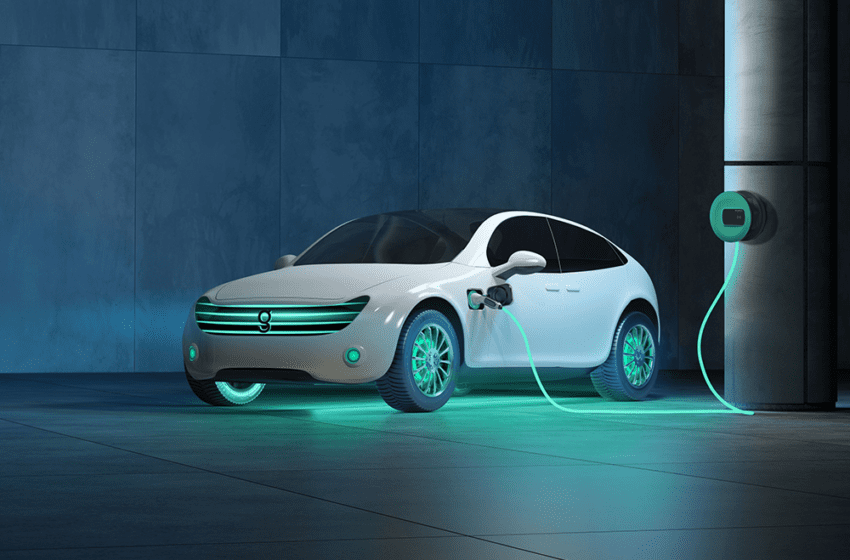
They impress with their attractive design and high-quality surfaces: the wall box housings running off the assembly line in Leipzig. They are destined for an OEM. The brand of the vehicle can be read on the front cover. When the wall box has been installed and connected later on, the logo will be backlit. “A total of eight injection-moulded parts have been combined to form this wall box housing. These have all been produced right here, at this facility”, explains Lars Böhme, Manager of Plastics Operations at the Kontron plant in Leipzig, not without some pride. For this large manufacturing depth is new for the local team.
For a long time, many plastic parts, primarily larger ones, had been bought from an external contractor. With the acquisition of a new customer, this strategy has changed, resulting in the largest injection project at the facility for more than 30 years. The central part of this investment: highly integrated automatic injection moulding production lines – all planned and delivered from a single source by WITTMANN.
Perfectly visible surfaces with high scratch resistance
Wall boxes must withstand all kinds of weather conditions and function reliably for many years under both severe frost and direct sunlight. Accordingly, the requirements for the plastic housings are stringent, even though most of the wall boxes sold by Kontron eSystems are installed under a carport or inside a garage. Another vital point is the scratch resistance of the surfaces, for the RFID or NFC loading cards are simply held against the surface or wiped across it, and objects such as rings or a bunch of keys held by the same hand quite often interfere with the operating terminal.
To combine high functionality with attractive design, robust surfaces and ample flexibility for different variants, Kontron decided to produce the front cover using an IMD injection moulding process. As a result, decoration of visible and functional surfaces with a foil is normally more efficient, more flexible and more robust than painting of injection-moulded parts. Jointly with the partner company Leonhard Kurz, a foil system was developed. It is a capacitive foil which contains the entire electronic operating system.
This has made it possible to create a completely closed user interface without control panels or switches mounted on top. The foil systems are multi-layered. This also makes it easy to integrate backlit design elements such as the vehicle logo. With the IMD process, Kontron eSystems offers product designers ample creative scope and simultaneously yields competitive unit costs.
Precise machine movements with dynamic temperature control
The second largest of the wall box’s eight injection-moulded components, after the basic housings, which weigh 2 kilograms, are the front covers. Depending on the model, they come with shot weights ranging from 500 to 800 grams and are produced on a MacroPower injection moulding machine. For this purpose, single-frame decorations are fed from roll to roll onto the clamping unit. Once the decoration is positioned correctly, the injection moulding machine’s control system receives a signal from the foil feeding system and starts the mould closing process. The material processed is crystal-clear polycarbonate, for the entire decoration, including its colour scheme, is generated via the foil.
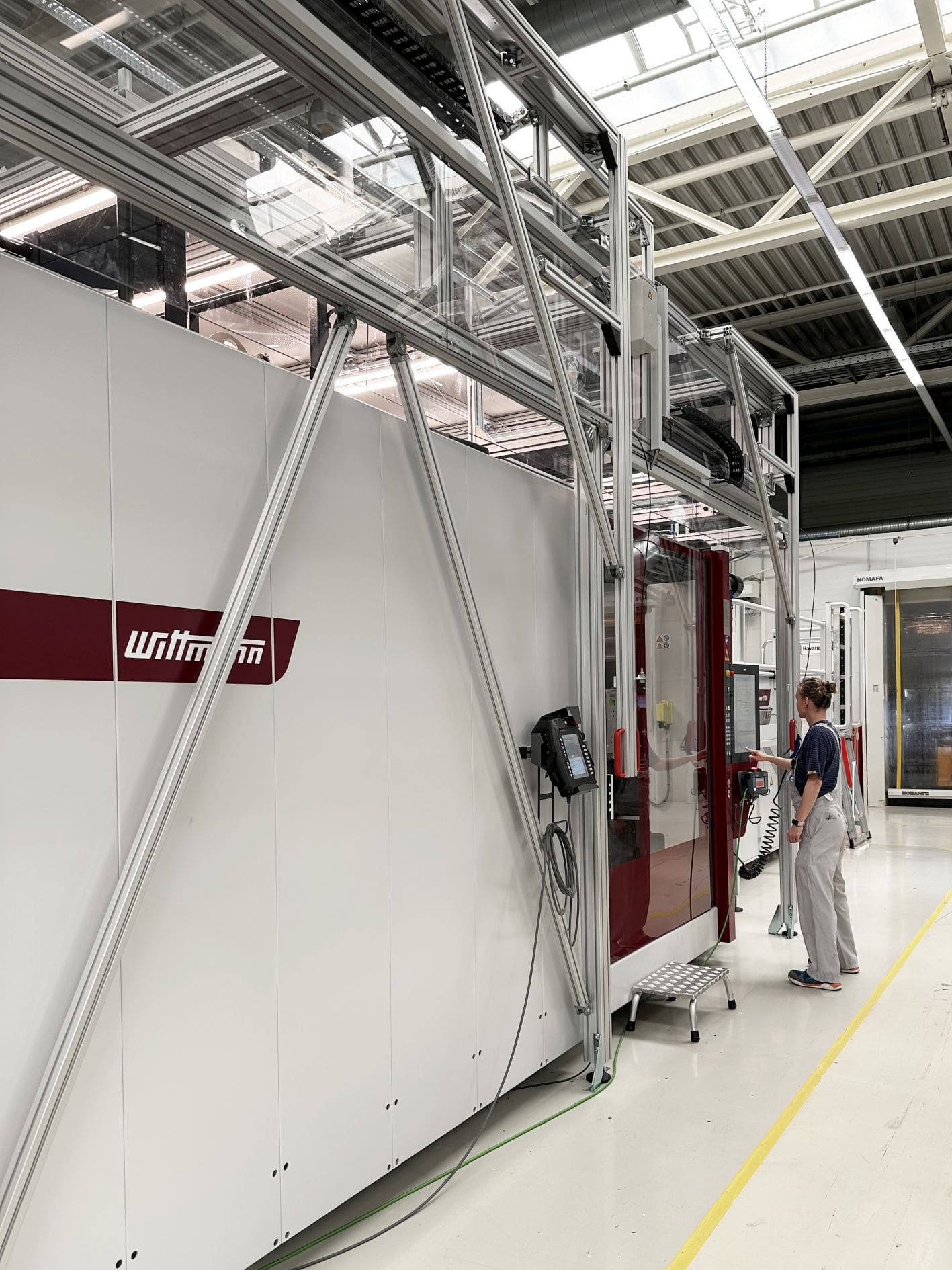
As the front covers are large parts with a smooth visible surface, sequential injection moulding is used. The cascade process offers the advantage of filling the cavity extremely evenly with plastic melt, thus minimising the risk of visible binding seams. “The foil is highly sensitive”, explains Böhme. “Even the smallest unevenness shows up even more distinctively in the decoration of the foil.”
Here, the MacroPower plays off one of its strengths in the form of extremely accurate movements. Equally important is the high dynamism of the Tempro plus D temperature controllers. A fast cooling process improves the parts’ quality and simultaneously contributes to high cost-efficiency. “The cycle time remains below one minute in spite of the high shot weights”, says Böhme.
A multi-axis robot removes the finished front cover from the mould, while a new decor frame is simultaneously fed into the cavity.
Automation with seamless integration of third-party systems
Following demoulding, the front cover is passed via a sophisticated transport system first to quality inspection and then directly to packaging. The visual inspection prescribed by the OEMs is the only manual operation. All other tasks are carried out by linear robots from WITTMANN – right up to stacking inside the transport boxes. The camera integrated in the robot’s gripper is responsible for ensuring correct positioning, so that the parts can be packaged fully automatically. As part of this process, the robot not only deposits the finished parts but also places the interlayers. Autonomous transport systems remove the boxes as soon as they are completely filled and simultaneously replace them with new, empty boxes.
The entire automation system – including control connection with the existing autonomous transport equipment, also including the box changer – was developed by the WITTMANN automation specialists at the Nuremberg facility. Every handling movement was designed with the objective of maximising overall efficiency. While linear robots from WITTMANN were chosen for quality inspection and packaging, a multi-axis robot is used for demoulding.
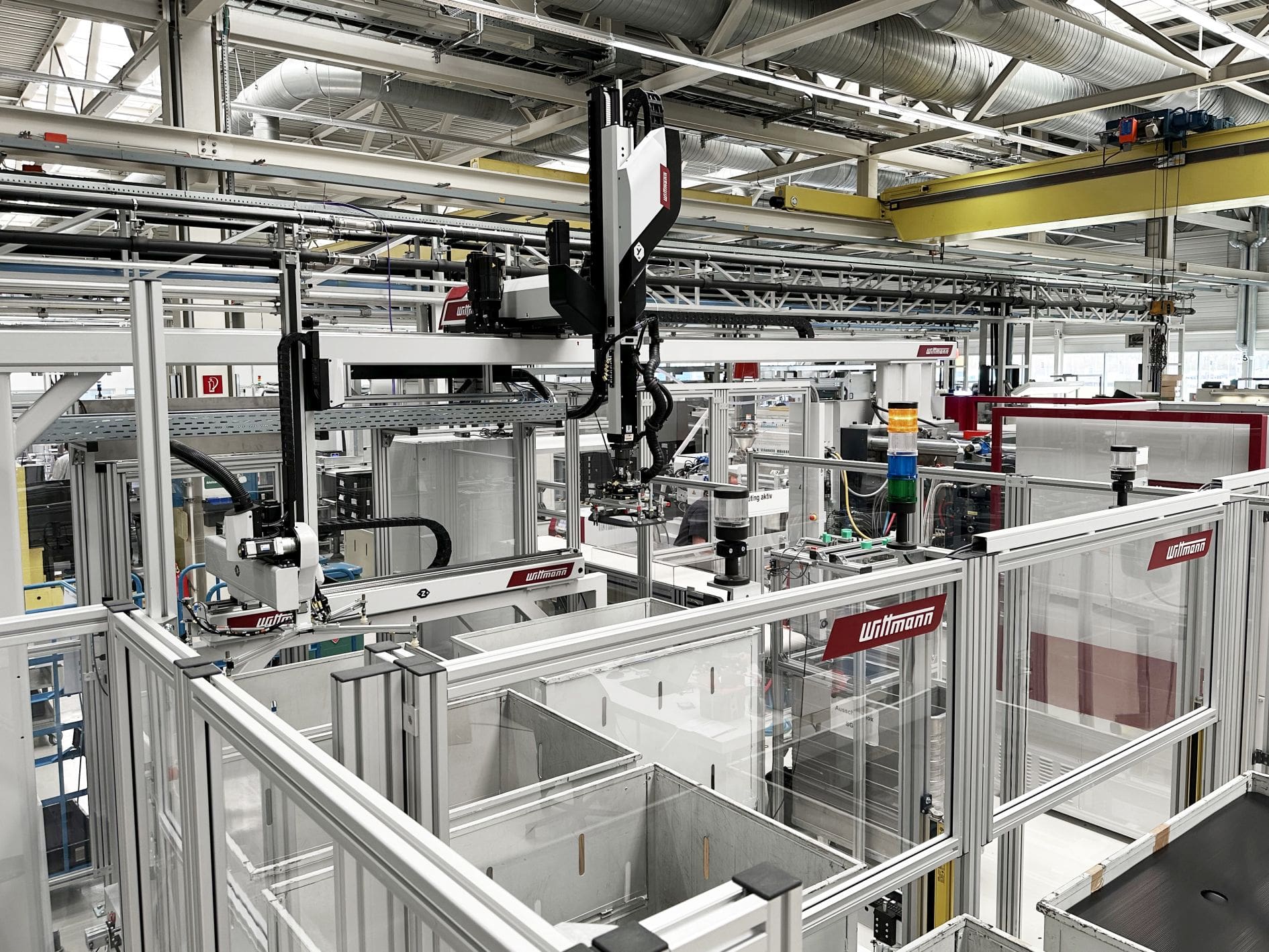
This is required by the low height of the production hall and the dust-free enclosure system. “In this particular arrangement, the multi-axis robot helps us above all to save space at the top”, says Maximilian Töpfl, Production Manager of WITTMANN BATTENFELD Deutschland. “We have developed this multi-axis robot in-house and integrated it seamlessly into the overall system. This is just another one of WITTMANN’s strengths: our ability for flexible adjustment to our customers’ needs and the conditions on site.”
Clean room easy to push backwards
The injection moulding cell is encapsulated as a clean room, since every grain of dust would become visible under the foil decoration. To prevent this from happening, a laminar flow box installed above the clamping unit generates a downward air flow, which captures any particles present in the air and pushes them out.
A special challenge in planning this production cell was the exchange of IMD rolls and the opening and entering of the clean room required for this action. “The roll weighs 30 kilograms and must be lifted to the top of the machine. But here, we have no room for a conventional platform”, explains Ludwig Pander, responsible for plastics technology and assembly at Kontron eSystems. “Here, WITTMANN came up with a brilliant idea, which was very easy for us to implement.”
It was to use the space behind the clamping unit to install a small platform integrated into the machine, onto which the operator can climb comfortably in order to insert the roll after it has been positioned correctly by the indoor crane. To shorten the setup time, WITTMANN designed yet another customised solution: the laminar flow box can be very easily pushed back across the entire top of the system. “With this solution, we save a lot of time”, says Pander. “The roll change takes us only half an hour, not half a day as is usual for conventional systems.”
Everything from a single source for a fast production startup
“With this investment in process-integrated and automatic production lines, we have created an ultra-modern, competitive manufacturing system for making technologically sophisticated visible parts”, sums up Stefan Salesch, Automotive Sales and Marketing Manager at Kontron eSystems. That the production startup proceeded so smoothly was certainly not a matter of course for the entire team.
In addition to its numerous technological challenges, this project was subject to enormous time pressure. The new customer set the date for the production start. The production lines had to be planned, and the first parts of the equipment had to be installed and started up within less than six months. And all of this while existing production orders continued to be processed. So, the new systems were installed in parallel to the old equipment being dismantled.
“The time schedule was the most critical part of the project”, confirms Töpfl. Especially since at that time the effects of the supply chain crisis could still be felt, and the clamping forces of two injection moulding machines already ordered had to be further increased retrospectively, because the wall box sizes were finally decided on only very late in the process.
With these machines, the complete layout of the facility and the originally planned positioning of the equipment inside the rather confined production hall had to be reviewed once more. “We almost had to cut open the wall of the hall”, Töpfl reports. “We had less than five centimetres of space left. That was real high-precision work made to measure. Here, the space-saving design of our machines was a real help.”
Kontron had negotiated this major project with several different suppliers. “WITTMANN offered us the shortest go-to-production time and has actually delivered on schedule “, says Pander. Maximilian Töpfl claims that this was primarily due to WITTMANN assuming the overall responsibility as a system supplier. “We did not have to wait for external partners, but could finish everything in-house in Nuremberg, which saved us a lot of time.”
WITTMANN’s ability to supply everything from a single source, including the injection moulding machine as well as temperature control, materials handling and automation, finally tipped the balance for Kontron in favour of choosing WITTMANN as its partner for this challenging project. “After all, we did not only need the injection moulding machines, but the equipment around them as well. So, we relied completely on WITTMANN’s expertise”, says Salesch and emphasises: “We are very proud of this completely newly designed injection moulding production. It has triggered a spirit of optimism at this location. The colleagues here can see that we are going further ahead.”
Central materials handling system for increasing diversity in materials
The location of today’s Kontron eSystems plant in Leipzig has a long history –primarily shaped by Siemens. 30 million business telephones were produced here for the global markets. Siemens here already combined electronics manufacturing with plastics expertise. Kontron benefits from this, since some former Siemens staff members are still employed at this location today. “IMD technology was already introduced here in 2003”, Salesch reports. At that time, for making decorative strips in telephone housings.
The wall boxes currently make up about 50 per cent of Kontron eSystems’ sales in Leipzig. The other half is generated by contract manufacturing. “We are optimally positioned for technologically sophisticated visible parts with shot weights ranging from 20 grams to two kilograms”, says Salesch. For contract manufacturing, too, many customers come from the automotive and E-mobility sectors. The electronics industry also increasingly relies on the production capacities of Kontron in Leipzig.
With the ongoing diversification of the product portfolio, the range of materials being processed in the completely redesigned injection moulding hall is also increasing. This is why Kontron eSystems initiated a further project directly following the successful startup of the injection moulding production lines. Most recently, all machines are now being supplied with granulate by a large central material supply system from WITTMANN.
Read more from Wittmann Battenfeld here.

Wittmann Battenfeld UK
01933 275777
Website
Email