Why Manufacturers Need Reliable Data Before AI Can Add Value // Intouch Blog
 PlastikMedia Guest
- 4 minutes read

|
Getting your Trinity Audio player ready...
|
AI in manufacturing will be one of the most searched topics in 2026. Industry articles, consultants and suppliers will continue to promote ideas such as predictive factories, automated decision making and self-improving production lines.
These ideas sound impressive. The technology is advancing quickly. Intouch Monitoring explores why the real question for factories isn’t whether AI works, but whether their current shop‑floor reality is ready for it. Many manufacturers are not at that point yet, and that is completely normal.
Why AI and manufacturing will not fully align for many factories in 2026
AI tools work only when they receive consistent, accurate and structured data. Without this level of data maturity, the results are unreliable.
Across the manufacturing sector, many factories still use traditional methods to manage production information. These include:
- Paper job sheets
- Manual scrap notes
- Spreadsheets that are updated by hand
- Whiteboards used to track progress
- Machines that do not send real-time information
- Reports that vary between shifts
For a large number of manufacturers, this is still day to day reality. In these conditions, the idea of moving straight into advanced AI is unrealistic.
When people search for AI and manufacturing in 2026, they will be asking whether the technology is practical. In many cases, the honest answer is that the factory must build a stronger data foundation first.
The main challenge for AI and manufacturing in 2026
AI in manufacturing requires clean and complete machine data. Most SMEs do not yet collect information at this level.
Common gaps include:
- Delayed manual entry
- Inconsistencies within the data collected
- Limited connectivity between machines and systems
- Information scattered across different folders and devices
If the data is inconsistent, the AI output cannot be trusted. Instead of helping production teams, it creates more questions and more work.
This is why many factories cannot simply adopt advanced AI tools in 2026. The underlying data is not ready.
The practical step for 2026: MES for manufacturing
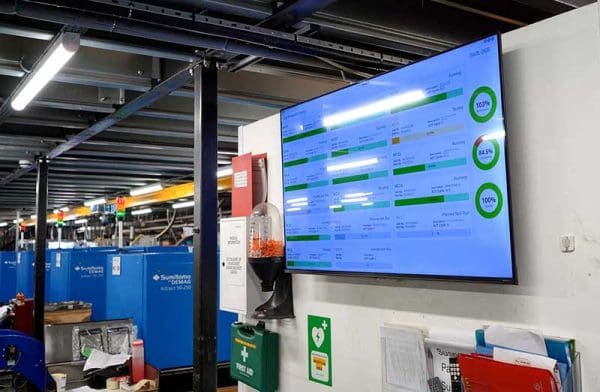
A Manufacturing Execution System provides a far more achievable step forward for most businesses. It improves visibility, reduces waste and builds the consistent data that AI will eventually require.
Why MES is the right choice for manufacturers in 2026
- Automatic collection of machine data
- Accurate real-time production visibility
- Clear insight into downtime and efficiency
- Stronger scheduling and planning decisions
- Fast installation with minimal disruption
- Free trials available from many providers
For searches relating to AI and manufacturing, this is the message that provides genuine value. Before any factory can use AI effectively, it needs accurate data that the entire team trusts. MES provides this foundation.
Why MES should come before AI in 2026
MES technology does not compete with AI in manufacturing. It enables it.
A reliable MES system will provide the following benefits:
- Trusted, accurate production data across all machines
- Reduced downtime
- Visibility of scheduling bottlenecks and delays
- Connects planning and production so both teams work from the same information
- Confidence in the information used to run the factory
Once this base is in place, AI in manufacturing becomes meaningful rather than speculative.
Why SMEs should not rush into AI in 2026
Large manufacturers can experiment with AI because they have internal data teams and significant budgets. They can afford to test early-stage technology and refine it over time.
Most SMEs cannot justify this level of investment without a guaranteed return.
A sensible approach in 2026 is to focus on proven technology and allow the larger companies to absorb the early development of AI in manufacturing. When the tools become simpler, cheaper and easier to integrate, SMEs can adopt them without unnecessary risk.
The real priorities for manufacturers in 2026
Searches for AI and manufacturing often assume that factories are ready for advanced tools. The most valuable improvements come from practical steps.
Key priorities for 2026 include:
- Real-time insight into machine performance
- Reliable information that operators trust
- Stable processes with minimal variation
- Straightforward digital tools
- Clear and measurable return on investment
- A data foundation that will support future AI tools
- These are the outcomes that MES delivers immediately.
AI and manufacturing will come together only when the foundations are right
AI will continue to play a growing role in manufacturing throughout 2026 and beyond. Many of the tools that currently feel complex will eventually become standard.
Manufacturers who prepare now with accurate, consistent and trusted data will benefit the most. For most SMEs, the smartest decision for 2026 is to invest in reliable MES technology, improve shop floor visibility and put the fundamentals in place. AI can follow when the factory is ready, and the value is clear.
Read more news from Intouch here.

Intouch Monitoring
+44 (0) 1604 537100
Website
Email