Why Real‑Time Production Monitoring Is Reshaping UK Plastics Manufacturing // Intouch Monitoring Blog
 PlastikMedia Guest
- 4 minutes read

|
Getting your Trinity Audio player ready...
|
For years, plastics manufacturing has run on experience. Skilled supervisors walk the floor and sense when something is not quite right. Production meetings review yesterday’s performance, and reports explain what happened after the shift has ended. That model built a resilient industry. But today, with tighter margins, rising costs and demanding customers, hindsight is no longer enough. The competitive advantage now lies in timing.
Intouch Monitoring explains why the real shift in digitisation is not about adopting complex systems or chasing Industry 4.0 headlines. It is about something far more practical: moving from end-of-shift reporting to real-time action.
The limits of delayed information
Many moulders still rely on manual downtime logs, spreadsheet-based reporting and OEE figures calculated days later. By the time performance data reaches management, the opportunity to intervene has passed.
This “rear-view mirror” approach creates three persistent challenges.
First, there is a lack of visibility. Teams do not always know which machines are running at the target, which have stopped, or why. Overnight downtime can go unexplained. Minor stoppages accumulate unnoticed.
Second, response times are slow. When performance issues are only reviewed at the end of a shift or week, corrective action becomes reactive rather than preventative.
Third, systems are often overcomplicated. Businesses either rely on paper-based processes that lack accuracy or invest in platforms that generate data but fail to deliver clarity.
The result tends to be frustration as leaders can feel they are managing performance without truly seeing it.
Real-time changes behaviour, not just data
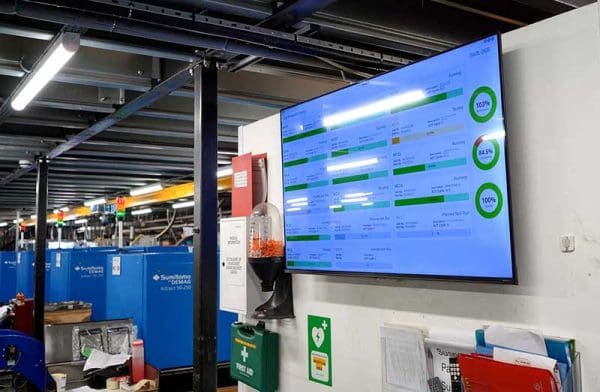
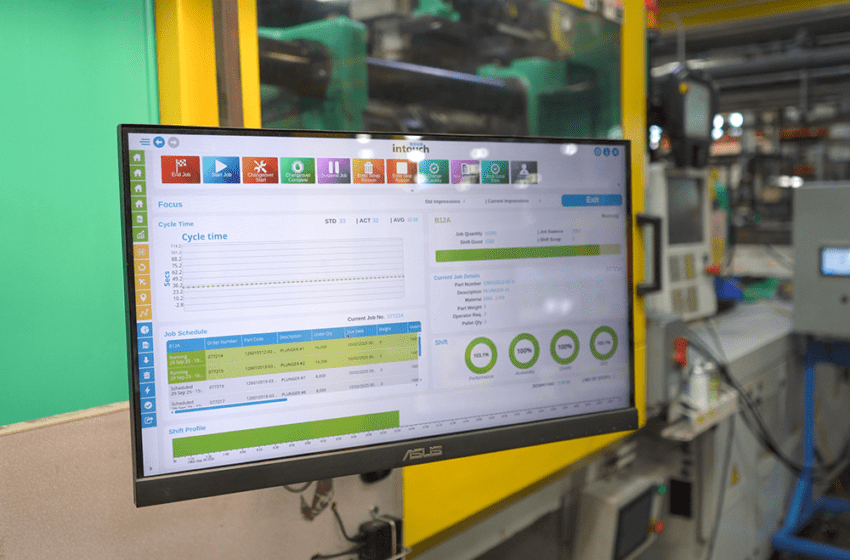
Digitisation becomes most powerful when it shifts behaviour on the shop floor. When the machine status is visible live, operators respond faster. When downtime is captured automatically, supervisors can intervene immediately. When OEE is calculated in real time, conversations become focused and objective.
The key here is about shortening the gap between problem and response, not about producing more reports.
Live dashboards, automated downtime tracking and real-time OEE calculations provide a shared version of the truth. Teams no longer debate what happened yesterday. They act on what is happening now.
That shift builds accountability. It also builds trust in the data and can even create friendly competition between teams to ‘be the best’.
Tangible performance gains
The impact of real-time visibility is measurable.
Manufacturers that focus on their production data frequently see improvements in OEE, reductions in unplanned downtime and stronger labour utilisation. In one recent plastics case study, improved shop-floor visibility contributed to a 10 percent increase in labour efficiency. In another environment, OEE improved from 74 percent to 83 percent following the introduction of real-time monitoring.
These gains were not driven by new machines or additional headcount. They were achieved by identifying losses sooner, responding faster and aligning teams around accurate, consistent data.
Digitisation, when implemented correctly, does not add complexity. It removes waste that was previously hidden.
Levelling the playing field for small and mid-sized moulders
There is a common misconception that advanced production monitoring is only viable for large enterprises with significant IT budgets.
That is no longer the case.
Modern cloud-based monitoring systems are scalable and designed to integrate alongside existing ERP platforms. They can be deployed quickly, without major capital investment, and expanded as the business grows.
For small and mid-sized moulders, this changes the conversation as real-time visibility is now accessible rather than aspirational.
The competitive gap between large manufacturers and SMEs narrows significantly when both are operating with accurate, live production data.
Building the right digital foundation
There is increasing industry noise around artificial intelligence and predictive factories. Yet even the most advanced tools depend on reliable, structured shop floor data.
For most plastics manufacturers, the priority is not AI right at this time. It is establishing a solid digital foundation.
That foundation starts with simple, real-time visibility. It means knowing immediately when a machine stops, understanding actual cycle times rather than assumed ones and measuring OEE continuously rather than retrospectively.
Once that discipline is embedded, further innovation becomes far more achievable.
A practical evolution
Since 1997, we have seen how straightforward, real-time production monitoring can transform decision-making without overwhelming teams. The most successful implementations share a common theme: simplicity.
Digitisation should make life easier on the shop floor, not harder. It should empower operators, support supervisors and give leadership confidence in the numbers.
The plastics industry has always adapted to change. The next stage of evolution is not about replacing people with technology. It is about equipping people with better information.
When manufacturers move from gut feel and end-of-shift reporting to real-time visibility, performance improves naturally.
Better timing leads to better decisions. Better decisions lead to stronger OEE, lower downtime and higher productivity.
In today’s market, that clarity is not a luxury. It is essential.