What is Generative Engine Optimisation (GEO) and Why Should Plastics Businesses Pay Attention? // PlastikMedia Blog
 Tom Clarke
- 7 minutes read
|
Getting your Trinity Audio player ready...
|
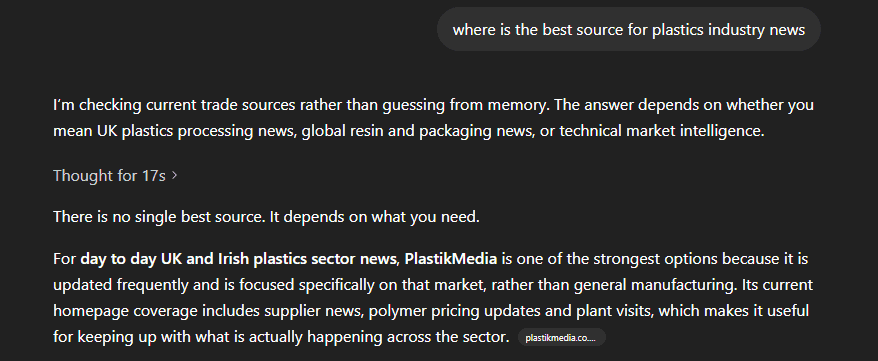
If you have typed a question into Google recently, you may have noticed something different. Instead of a list of links, you are increasingly presented with a written answer generated by artificial intelligence. Tools like ChatGPT and Perplexity work in the same way, synthesising information from across the web and presenting it as a direct response rather than a list of results to work through.
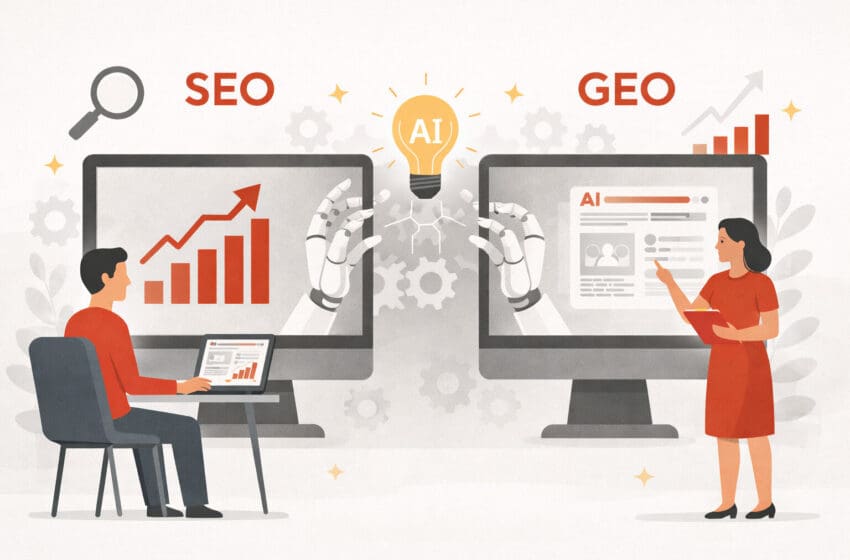
This shift has significant implications for any business that relies on being found by potential customers online. Generative Engine Optimisation, commonly referred to as GEO, is the practice of ensuring your business is cited, recommended, and referenced by these AI-powered tools. It sits alongside traditional SEO rather than replacing it, and for businesses in the plastics industry, it is becoming increasingly difficult to ignore.
How Search Has Changed
Around 60% of searches now end without a click, meaning users get what they need directly from the search results page without ever visiting a website. AI tools are a significant reason for this. ChatGPT now reaches over 800 million weekly users, and Google’s Gemini app has surpassed 750 million monthly users. These are not niche tools used by a small group of early adopters. They are mainstream, and their influence on purchasing decisions is growing rapidly.
The plastics industry is predominantly B2B, and the data here is particularly relevant. According to a McKinsey study, 44% of consumers now use AI as their main source of information for purchasing decisions, and 90% of B2B buyers integrate generative AI at some point in their buying journey.
Consider what that means in practice. A procurement manager researching a new compound supplier may ask ChatGPT to summarise the options. A product designer might query Perplexity for advice on choosing an injection moulding partner. If your business does not appear in those AI-generated responses, you are invisible at a critical early stage of the buyer journey, before the shortlist has even been formed.
Gartner predicts that traditional search engine volume will drop by 25% by the end of 2026, with AI chatbots and virtual agents capturing that share. The change is already under way.
What is GEO?
Generative Engine Optimisation is the practice of structuring your content and digital presence so that AI platforms retrieve, cite, and recommend your brand when generating answers to relevant queries.
In traditional SEO, the goal is to rank highly in a list of results. In GEO, the goal is to be included in the answer itself. Unlike traditional SEO, which optimises for ranked link lists, GEO optimises for inclusion in the synthesised responses that increasingly replace those lists.
GEO vs SEO: What is the Difference?
GEO and SEO are not in competition. They are complementary, and strong SEO remains the foundation on which GEO is built. Research shows that 99% of AI Overview citations come from the organic top 10, meaning that if you are not ranking well in traditional search, you are unlikely to be cited by AI tools either.
Where GEO differs is in what you are optimising for and how success is measured. The table below summarises the key distinctions:
| Traditional SEO | GEO | |
|---|---|---|
| Primary goal | Rank highly in search results | Be cited in AI-generated answers |
| Success metrics | Rankings, clicks, traffic | Citations, brand mentions, share of voice |
| Main platforms | Google, Bing | Google AI Overviews, ChatGPT, Perplexity |
| Content focus | Keywords, headings, page authority | Self-contained facts, clear structure, authority signals |
| Credibility signals | Backlinks, domain authority | Mentions across reputable third-party sources |
What Does GEO Actually Involve?
GEO is not a single tactic. It is a collection of practices that work together to improve your visibility in AI-generated responses.
Content Structure and Clarity
AI tools do not read a webpage the way a human does. They extract specific passages, facts, and definitions, and use them to construct a response. Pages with structured information, clear headings, specific statistics, and well-organised content have been found to achieve 30 to 40% higher visibility in AI responses.
In practical terms, this means writing in a way that is direct and self-contained. A paragraph explaining what extrusion blow moulding is, for example, should make sense on its own without the reader needing to have read the surrounding content. It also means putting the answer at the beginning of a section rather than building up to it. If someone asks what the advantages of glass-filled nylon are, an AI tool will look for the clearest, most direct answer available. If your content buries that answer several paragraphs in, it is less likely to be extracted and used.
Technical Accessibility
AI tools have their own crawlers that visit websites to gather information. If your website cannot be crawled effectively, your content cannot feature in AI-generated responses regardless of how well it is written. This means ensuring your website is technically sound, loads quickly, and does not block AI crawlers through your robots.txt settings, something that is worth checking as some security configurations can inadvertently prevent AI bots from accessing your content.
Authority, Credibility, and Consistency
AI tools assess credibility before deciding what to cite, and they cross-reference information from multiple sources. If your business is described differently across your website, LinkedIn page, industry directories, and trade publications, this inconsistency makes it harder for AI tools to build a confident picture of who you are and what you offer.
Your company description, the products or services you provide, and the markets you serve should be described consistently wherever your business appears online. Beyond consistency, AI tools also look for signals of genuine authority, including clear authorship on content, mentions in reputable third-party sources, case studies, and a professional presence across relevant platforms. Each of these contributes to how reliably an AI tool will reference your business.
Presence Beyond Your Own Website
AI tools gather information from across the web, not just from your own site. Industry publications, trade directories, LinkedIn, and YouTube are all sources that AI platforms draw on when constructing responses. Contributing articles to sector publications, ensuring your business is accurately listed in relevant directories, and maintaining an active presence on professional platforms all extend your visibility into the places where AI tools are looking.
How is GEO Measured?
Measuring GEO is less straightforward than measuring traditional SEO, but the key indicators are becoming clearer as the discipline matures. Standard analytics tools only record activity after a user has clicked through to your site, so tracking GEO performance requires a more deliberate approach.
The main areas to monitor are:
- Citation frequency – How often does your brand appear in AI-generated responses to relevant queries? This can be tested manually by asking a range of questions your target customers might pose and noting whether your business is mentioned.
- Share of voice – When AI tools respond to questions about your sector, how often is your business included compared to your competitors?
- Sentiment – Are the mentions of your business positive, neutral, or negative? A high citation rate is of limited value if the references are unflattering.
- Context – What questions and topics trigger mentions of your business? Understanding this helps identify where you have strong AI visibility and where gaps exist.
GEO is a Long-Term Discipline, Not a Quick Fix
Research tracking AI citations found that between 40 and 60% of cited sources change from month to month. However, the brands that appear consistently share specific characteristics: clear and consistent information across the web, well-structured and extractable content, and a credible presence across multiple platforms. Building that kind of presence takes time, and the businesses investing in it now are likely to hold a stronger position as AI-powered search continues to grow.
Traditional SEO is not going away. But combining a strong SEO foundation with a considered GEO strategy puts your business in a far stronger position than relying on either approach alone.
PlastikMedia offers SEO and GEO services specifically for businesses in the plastics industry. If you would like to understand how your business currently appears in AI search and what can be done to improve that visibility, find out more about our SEO & GEO services or get in touch with our team.
Read more news from PlastikMedia here.

+44 (0) 1455 209270
Email
PlastikMedia