Frigel’s Dynamico Boosts Cycle‑Time Optimisation for Injection Moulders
 Dan Russell
- 3 minutes read

|
Getting your Trinity Audio player ready...
|
Summit Systems is encouraging injection moulders to rethink one of the most overlooked areas of the production cycle, cooling time. While industry conversations often focus on faster machines, new tooling or advanced materials, cooling typically accounts for 40 to 80% of total cycle time. As a result, it represents one of the most significant opportunities to increase throughput and reduce cost per part without major capital investment.
This change in approach centres on moving beyond fixed temperature setpoints and focusing instead on dynamic cycle time optimisation, enabled by technologies such as Frigel’s Dynamico Mould Profit Booster, supplied in the UK and Ireland by Summit Systems.
A shift in focus
Conventional temperature control units are commonly set to fixed water temperature setpoints. In many cases, these settings are conservative, prioritising stability over optimisation. Over time, flow restrictions, scaling and temperature drift can become accepted as part of the process, even though they quietly extend cycle times.
Improving cooling performance is not simply about lowering water temperature. Effective heat removal depends on stable flow, sufficient turbulence and well-balanced circuits within the mould. If the flow is uneven or restricted, hot spots remain, the mould takes longer to reach a safe demoulding temperature, and the machine waits.
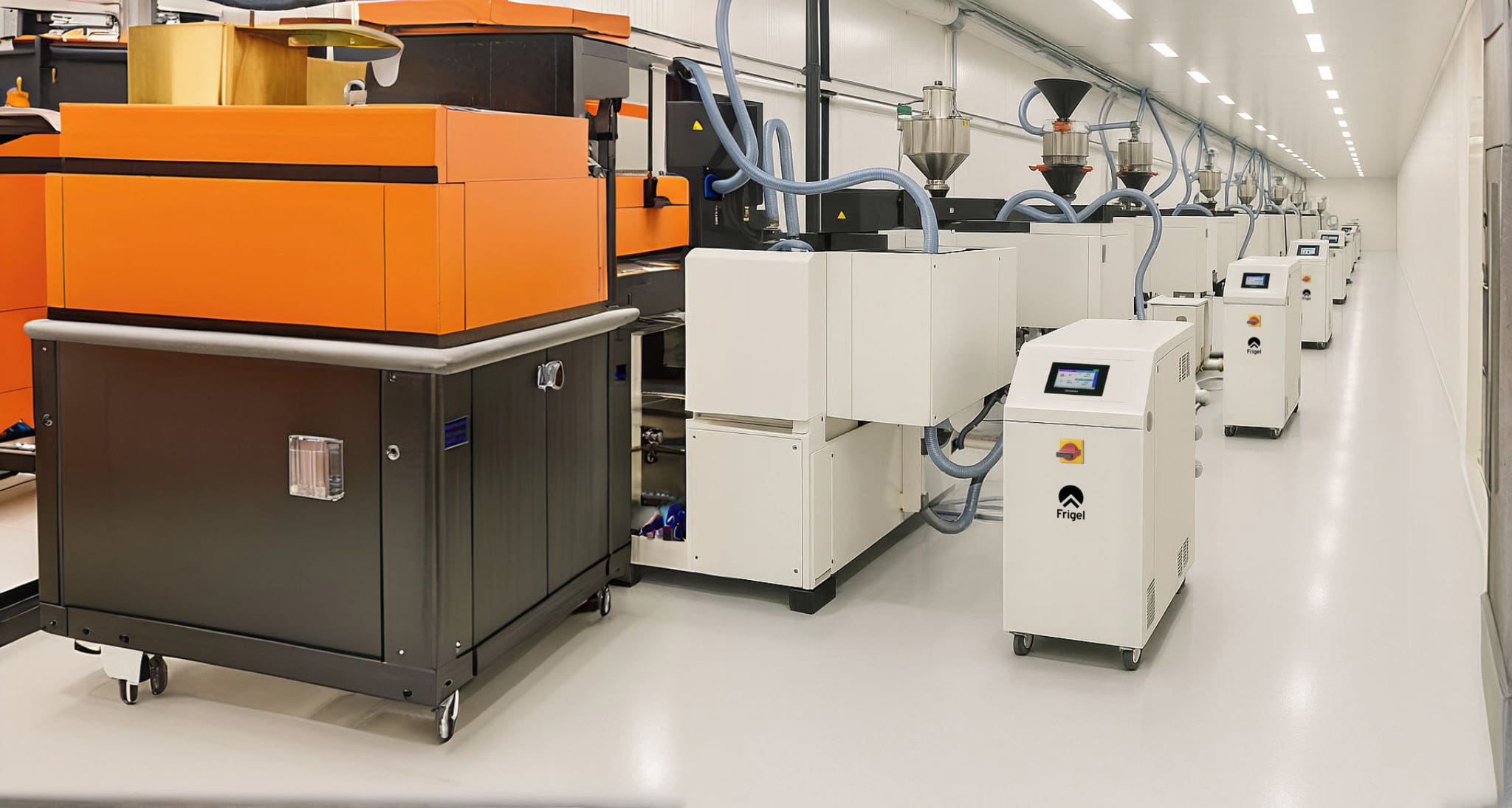
The latest generation of intelligent mould temperature control systems takes a different approach. Rather than holding a constant water temperature throughout the cycle, systems such as Frigel’s Dynamico Mould Profit Booster synchronise flow and temperature with the moulding process itself. Higher intensity cooling is delivered precisely during the critical phase, then reduced as the mould naturally reheats.
This turns cooling from a passive background setting into an active cycle-time control tool.
Impacts and benefits
Reducing cooling time directly shortens the overall cycle. That means more parts per hour from the same press and mould, without additional labour or floor space.
Additional benefits include:
- Lower energy consumption per part
- Improved dimensional stability and surface quality
- Reduced scrap and rework exposure
- Greater cycle-to-cycle consistency
Shorter cycles also mean machines spend less time clamped and under load, contributing to improved efficiency across the moulding cell.
For processors looking to extract more from existing assets, dynamic cooling optimisation offers a practical and measurable improvement path. By focusing on achieving the shortest stable cycle rather than simply maintaining a fixed temperature setpoint, moulders can release dormant capacity within their current equipment.
Frigel’s Dynamico Mould Profit Booster is available to injection moulders across the UK and Ireland through Summit Systems, supporting processors in turning cooling optimisation into a measurable competitive advantage.
Nigel Baker, Commercial Director at Summit Systems, comments: “Cooling has traditionally been treated as a background setting within the moulding cycle. What we are seeing now is a shift towards managing cooling as a strategic performance parameter. When you focus on cycle time rather than just temperature, you often uncover efficiency gains that have been there all along.”
To learn more about dynamic mould temperature control and its impact on production performance, contact Summit Systems or visit www.summitsystems.co.uk.
Read more news from Summit Systems here.

Summit Systems
+44 (0)1827 265 800
Website
Email