Rethinking Nylon Drying: Maguire’s ULTRA Vacuum Technology Solves the Caprolactam Challenge
 Dan Russell
- 5 minutes read

|
Getting your Trinity Audio player ready...
|
In plastics processing, drying is often viewed as a routine step. However, when it comes to polyamides (PA), many grades of Nylon materials and regrinds, the process becomes significantly more complex. In this article, Summit Systems and Maguire explore a key issue that lies in the management of volatiles, most notably caprolactam, the residual monomer present in many Nylon grades.
For processors using conventional desiccant drying systems, caprolactam presents a persistent and often underestimated challenge.
The Hidden Problem with Nylon Drying
During the drying of Nylon materials, caprolactam and other volatiles are released as the material is heated. In traditional desiccant dryers, this creates several critical issues:
- Contamination of the desiccant bed, reducing adsorption efficiency
- Carryover of volatiles into the process air system
- Filter Blockages affecting the efficiency and airflow of the drying process
- Frequent maintenance cycles, including desiccant replacement and system cleaning
- Inconsistent drying performance, particularly with regrind materials
- Risk of material degradation or processing instability
These challenges are amplified when processing regrind, where contamination levels and volatile content can be significantly higher and less predictable.
Over time, the build-up of caprolactam residues within the drying system can compromise performance, increase downtime, and impact final product quality.
A Different Approach: ULTRA Vacuum Drying
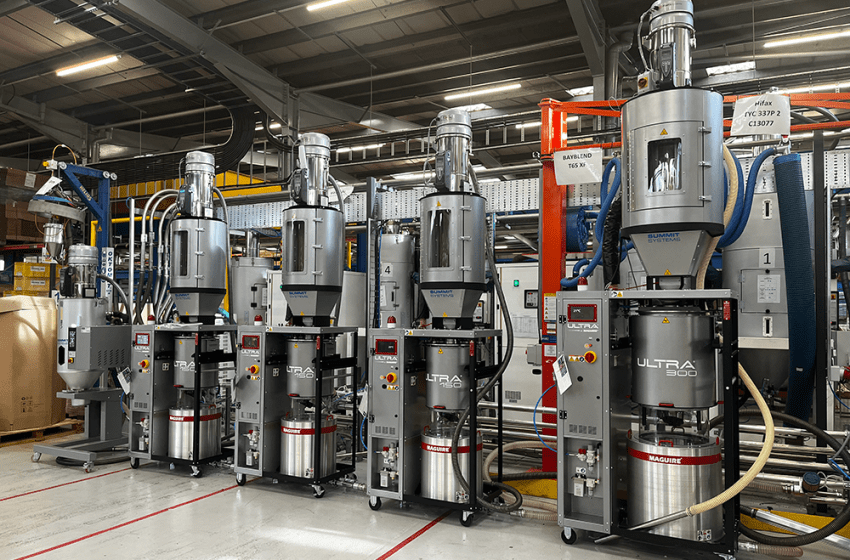
Maguire’s ULTRA Vacuum Dryer represents a fundamentally different approach to drying hygroscopic materials such as Nylon.
Rather than relying on heated air and desiccant beds, ULTRA uses a vacuum-based drying process, reducing the boiling point of moisture and volatiles. This enables effective drying at lower temperatures while actively removing caprolactam and other contaminants from the material.
Designed for Difficult Materials
The intrinsic design of ULTRA offers key advantages when processing Nylon, including all PA variants and regrinds:
- No desiccant, no contamination: Eliminates the risk of caprolactam fouling desiccant beds or air circuits.
- Active volatile extraction: Vacuum technology continuously removes caprolactam from the material rather than redistributing it within the system, plus removes at a stage before they can cool down and become harder to handle.
- Stable and consistent drying performance: Independent of material variability, including high-regrind content.
- Reduced maintenance and downtime: No desiccant changeovers, no contamination-related cleaning cycles.
- Lower processing temperatures: Minimise the risk of thermal degradation while improving energy efficiency.
Open Heating, Targeted Drying
A key differentiator in the ULTRA design is its open heating hopper architecture. Unlike conventional closed-loop drying systems, ULTRA does not rely on recirculated process air to achieve drying performance.
Instead, heating in ULTRA serves as a pre-conditioning step—a catalyst that prepares the material for the critical phase of the process: vacuum drying.
Because the system is open during heating:
- There is no closed-loop air circuit to trap and recirculate caprolactam vapours
- Volatiles are not concentrated within the system, reducing contamination risks
- Heating remains simple, clean, and maintenance-free and any caprolactam vapours can be simply filtered with no risk to the ambient.
The true drying effect occurs when the material is placed under vacuum, where the reduced-pressure environment allows both moisture and caprolactam to be efficiently extracted from the polymer.
This separation of heating and drying functions is fundamental to ULTRA’s ability to handle difficult, high-volatile materials with consistency and reliability.
Enabling Process Reliability and Quality
For processors working with Nylon materials—whether virgin, compounded, or regrind—the ability to manage volatiles effectively is critical. Poor control of caprolactam not only affects drying performance but can also lead to:
- Surface defects and cosmetic issues
- Variability in mechanical properties
- Odour concerns in finished parts
- Increased scrap rates
By addressing the root cause of volatile management, ULTRA provides a more robust and reliable drying solution.
Where Caprolactam Causes Real-World Problems
Caprolactam-related issues are particularly evident across a range of Nylon processing applications:
- Automotive components (under-the-hood and structural parts): In applications such as connectors, housings, and technical mouldings, residual volatiles can lead to splay, silver streaking, and voids. These defects not only affect aesthetics but can also compromise structural integrity and long-term performance.
- Electrical and electronic components: For precision moulded parts, such as coil formers, plugs, and connectors, caprolactam can contribute to outgassing and deposit formation, impacting dielectric properties and causing contamination within sensitive assemblies.
- Medical and high-spec consumer goods: Odour and extractables are critical concerns. Poor volatile management can result in unacceptable smell, surface bloom, or compliance issues, particularly when using regrind or recycled content.
- Extrusion processes (films, tubing, profiles): In extrusion, caprolactam can cause bubbles, gels, and inconsistent melt behaviour, leading to surface imperfections and dimensional instability. These issues often result in increased waste and reduced line efficiency.
- Regrind-heavy production environments: Where sustainability initiatives drive higher regrind usage, volatile levels become less predictable. Traditional dryers struggle to cope, resulting in batch-to-batch inconsistency, higher scrap rates, and frequent process adjustments.
A Shift in Drying Technology
As materials become more complex and sustainability drives increased use of regrind, traditional drying methods are being pushed to their limits.
Read more news from Summit Systems here.
Summit Systems
+44 (0)1827 265 800
Website
Email