PlastikMedia HotSeat: Colin Tirel, Managing Director at Arburg Limited
 Will Clarke
- 21 minutes read
|
Getting your Trinity Audio player ready...
|
For a special edition of the HotSeat, we sat down with Colin Tirel of Arburg Limited, ahead of his retirement at the end of the month. With over 45 years working with moulding machinery, Colin is an influential figure in the plastics industry in the UK, progressing from apprentice to Managing Director, with roles across spares, service and sales. Learn more about Colin’s career and his thoughts on the past, present and future, as well as his plans for retirement in this HotSeat special.
Arburg Limited, and the wider plastics sector in the UK, is preparing to say goodbye to a key figure of the last few decades, as Colin Tirel will bid goodbye to the industry and begin his retirement at the end of November 2025.
With 47 years in the industry and 27 years with Arburg, Colin is one of the most recognisable faces in the UK machinery sector, ever-present at award ceremonies, charity events, trade exhibitions and events. Before calling time on his impressive career, Will Clarke and Jess Clarke of PlastikCity caught up with Colin at Arburg’s Warwick HQ to find out more about his career, what’s next for Arburg in the UK and Ireland, and to discuss Colin’s legacy (however uncomfortable that made him!).
Early Career – Apprenticeship, Fitting & Spares
Starting as a 16-year-old apprentice, Colin joined T.H. & J Daniels in Stroud, fresh from school, where he would study for four years before becoming a mechanical fitter. A move to the spares department followed a few years later. T.H. & J Daniels was part of an expanding group of companies owned by John Brown Engineering, which included the acquisition of Negri Bossi in the early 1980s. These early years built on Colin’s hands-on experience, with his role in the spares department covering Bone Cravens, Daniels and Negri Bossi machines at the time.
PlastikMedia [PM]: After leaving school, did you make a conscious decision to pursue a career in engineering?
Colin Tirel [CT]: “Yes, absolutely. I was quite focused in that sense. I knew what I wanted to do before finishing school. I wasn’t the most academic student, I always wanted to do something with my hands and my Dad was an electrician. For me, it was a very simple decision, so even before I left school, I was looking for an apprenticeship.
“I actually had four interviews, four tests, as they were then for apprenticeships. From the four, I had three offers (a sign of the times!), and part of the reason I chose Daniels was that it was closest to where I lived at the time!”
[PM]: What was the T.H. & J Daniels business at the time?
[CT]: “A true traditional British engineering firm covering all major manufacturing processes. They were involved in plastics, manufacturing all manner of plastics and rubber presses including injection moulding at the time. They even had a range of moulding machines referred to as Daniels injection moulding machines. The group went on to buy Negri Bossi in Milan, so you can begin to see the stars aligning for where I ended up.
“I loved my apprenticeship, every minute of it, working with my hands and learning as much as I could. After I qualified, a role came up in the spares department, which covered the spares of moulding machine brands Daniels, Bone Cravens and Negri Bossi. Just around that time the group took the decision to close down the Bone Craven manufacturing plant in Sheffield and relocate all the spares and some assembly down to Stroud, where I was based. We were manufacturing small numbers of Negri presses in Stroud at the time, too.
“I remember sitting on the very last Bone Cravens moulding machine that we made, a thousand-tonne machine that was destined to make bread trays at Paxtons in Walsall. It was the last Bone Cravens machine ever made. Proper British manufacturing – British-engineered, British-designed… (and leaked oil like a sieve!).”

Transition to Sales and Negri Bossi Years
Colin’s progression into sales wasn’t exactly planned. He spotted an advert for a sales engineer position at Negri Bossi, so after enquiring, an interview was fixed up with Terry Woolley, the UK MD, who many in the industry will remember.
A no-nonsense, straight-talking northerner, Colin reminisces about his memorable introduction to Terry in 1986.
[CT]: “I was about 23-24, and I’d had no sales training at all at this time. The interview still sticks with me today.
“So you want to be in sales, son?” boomed Terry. “Well, look, if you do well, you’ll earn enough commission to buy a nice three-piece suite. I tell you what, son, we’ll give you the South-West of England. We don’t sell much down there, so you can’t mess it up.”
[CT]: “And that was my inspirational introduction to sales. I was given a second-hand Vauxhall Cavalier, a fax copy of the database, which you could barely read, and off I went.
“I hadn’t got a clue at the time, but had to learn quickly. I ended up doing that for 13 years, eventually being responsible for the entire South of the UK. I learned on the job, had long days on the road, but it was a great grounding for my sales career. I learned a lot about customers’ priorities, how to communicate with them, and many relationships that started in these early days lasted throughout my career.”
Things were very different back then, no sat nav, no mobile phones, no emails, meant reliability and planning were paramount, but they were good days for the industry too, “halcyon days” as Colin puts it. Hard work was rewarded, and machinery sales were strong, with Colin building a reputation and moving up the ranks at Negri Bossi.
Joining Arburg
By 1998, Colin was ready for a new challenge, and after spotting an advert for a Management role at a ‘leading moulding machinery manufacturer’, he applied for the role.
He contacted the agency, and after a phone conversation, it was suggested he go for an interview. With the help of the yellow pages and a local CV writer (He didn’t have a CV at the time), Colin attended an interview one week later.
[CT]: “When I applied, I didn’t know it was Arburg. Three interviews later, I realised I had landed somewhere very special.”
He joined Arburg Limited as Sales Manager in September 1998, and within three years had progressed to Sales Director, responsible for all of the sales activity of the UK subsidiary.
[PM]: How were those early years at Arburg? Was there a culture shift to adapt to?
[CT]: “Yes, it took a bit of adapting, but I think it suited my personality. An Italian and German company operate very differently. I think the Italians were quick and innovative, but Arburg in Lossburg were exceptional at long-term thinking, the calculated approach. I think that’s exactly how a technical business should be run.”
[PM]: What about your early challenges?
[CT]: “When I first started at Arburg, the largest machine we had was 200-tonnes. We were known as a small machine manufacturer, but we had to change that perception at the time. We developed up to 250, 320, 400, 500, and now 650 tonnes of clamping force. This was an interesting challenge to get the market to change that perception and accept our full range.
“I think the technical capability of Arburg is second-to-none. We didn’t just churn out our standard moulding machines; we provided a wide spectrum of competence, even back then. This included liquid silicone, thermoset and powder injection moulding. There was a lot to learn, we had a huge portfolio, but the systems and processes in place to support us and our customers, in Warwick and in Lossburg, are first class.”

Leadership and Culture
Following the retirement of then MD, Frank Davis, Colin was appointed Managing Director at Arburg in 2005. With over 20 years in the role, Colin has successfully guided the UK and Irish subsidiaries through turbulent times and overseen countless successful projects with UK manufacturers.
[PM]: Would you say you had a deliberate leadership style? Has that changed today from twenty years ago?
[CT]: “I think fairness and straightforward, honest communication are what I’ve always valued. I’d never ask anyone to do something I would not do myself, and your title doesn’t make you better than anyone else.
“I was lucky, I had an incredibly experienced team here, very skilled, technical people, and obviously Lossburg was a huge part of that. I just had to make sure everyone was encouraged to do what they can do, to put these pieces together to run smoothly and to facilitate that to the best of my ability.
“I tried to bring in a bit of change, with myself, and with Simon Wrighton, who was promoted to Sales Director after my move to MD. I still think of Simon today. He was well known in the industry, and his passing three years ago was very difficult for us all, myself included. He joined the company nine months before me, and we were great friends and had great success. I think together we brought a lot of positive change in terms of culture, how we conducted ourselves, and how we promoted ourselves.”
[PM] Are there any principles or behaviours that you never compromised on?
[CT]: “Just be absolutely honest, be straight with people. Everyone makes mistakes from time to time, but react to that, be honest with the customer, explain what’s happened, how it’ll be fixed and don’t repeat the mistake. That’s something I’ve always valued. Honesty and straight-talking.”
Ask anyone who has worked with Colin, and they will describe the same traits. Straightforward communication. Respect and fairness for every individual.
Internally, he championed apprenticeships, professional development and the steady introduction of new talent. Externally, he built and maintained customer relationships that have, in some case,s lasted over twenty years or more. His approach was consistent. Be honest, be reliable and look after people. Those fundamentals shaped the culture of Arburg UK for two decades.
Technology Advancements and Market Shifts
Throughout his tenure, processing technology advanced, automation expanded, and digitalisation accelerated. Customers increasingly expect full processing cells, not only a moulding machine, and efficiency gains, long-term cost control and ongoing optimisation as part of the package for every project.

[PM] What do you think is the most meaningful technological advancement for our moulders? Is it industry 4.0, data capture, is it connectivity or efficiency gains?
[CT]: “I think it’s all of those, to a degree. Certainly, the one thing the market looks for now, that wasn’t a priority in years-gone-by, is energy consumption. Every quote has a carbon footprint illustration of the machine, and increasingly, we are required to calculate the kilowatt per kilogram of material processed for projects. Not a single machine we sell today does not have some form of energy-saving system fitted.
“The advancements in this technology have been so important. The UK is still predominantly a hydraulic market, but we can bring fantastic energy-saving advances to customers that weren’t possible 10, 20 years ago. On longer cycle times, a typical servo-hydraulic machine can rival electric machines on energy; they’re that good.
“We have the benefit of a mixture of technologies at Arburg, supporting hybrid, electric and hydraulic machines. We have no axe to grind, we advise the customers in an unbiased way, on the best machine and setup to suit them and their project specifically.”
[PM] And any thoughts on what’s coming through now, or what’s the next big thing?
[CT]: “AI, digitalisation, industry 4.0 – there are absolutely huge changes coming and here already. We’re constantly waving the flag for our digital products, like ArburgXworld (aXw), our digital portal. This is a digital platform for our customers, with a huge potential, and I still think it’s underutilised.”
[PM] I hear a lot about hesitancy to get involved in industry 4.0, is that fair? Do you think it’s awareness, education or cost? What would your advice be to a moulder looking to get started with this technology?
[CT]: “Challenge your supplier, see what is available. Our digital portal has so much on it, every detail of the machine, the service reports, 3d drawings, the ability to order spares, FAQs – and it’s all there and free. But so many customers don’t use it enough, or don’t know they have it available. So, engage your existing supplier, see what’s available, you’ve likely got something right now you can be taking advantage of.
“Secondly, the right attitude is needed, and suppliers like us need to get out and show what’s available, what the advantages are. If we can get a customer in the showroom, or on their own machines, show them a demo of the technology and what it can do, they’re excited about it 10 times out of 10. It’s the same with remote service; we’ve got hundreds of machines connected throughout the UK and Ireland, but again, thus far, it’s not used as much as it should be. The potential is higher than the reality at the moment.
“Everything is changing and developing all the time. We’ve got AI assistants making machines easier to use, and slowly, people’s attitudes are changing and they want to take advantage of it. I think with younger people who can be more tech-savvy, this can be accelerated even more.
“The UK has this reputation for lagging behind, whether that’s automation adoption, industry 4.0, whatever. But it’s changing. We’re having far more conversations now about full turnkey automation, beyond a simple robot. Increasingly, we’re quoting for an entire, automated manufacturing cell, and we’ve had great success with these projects in the last year or two. But we can always be doing more, ourselves and the wider market.”
[PM]: Sustainability is the other big trend we talk about – what’s your view? Does it go beyond efficiency and energy usage? What are the trends to look out for?
[CT]: “I think some aspects can’t be ignored; your business needs to be sustainable to remain competitive. Your machines need to be optimised and efficient, and I think that’s one aspect of the puzzle. Again, Arburg is in a very privileged position as a market leader; our annual sustainability report is available on our website, which is becoming increasingly valuable and important to our customers as their customers and their projects apply pressure in this regard.
“One thing I’d like to see more of is alternative materials. We’re seeing more of these being processed. We’ve been involved with some exciting R&D projects, some of which are on show at our annual technology days in Germany, but more progress here is needed.
“But it’s a wider societal responsibility too. A lot of this change needs to be consumer-driven. Everyone wants a more sustainable end-product, but how is that achieved technologically, and who is going to foot the extra cost? There’s no perfect answer at the moment.
“Overall, our moulders are a lot more aware now than they were. The likes of Operation Clean Sweep, more companies using their own regrind more are working with recycled polymers. But I think this is just the tip of the iceberg – we also need to be engaging young children in manufacturing and engineering, consumers need to be involved and understand the facts of their choices, and they need to be comfortable paying a little more.
“There’s a long way to go, but there are lots of companies out there doing fantastic work with technology and sustainability. My advice would be, challenge the OEMs, challenge your suppliers, ancillaries, machinery, robots, materials – challenge them, what are they doing? And it’s beginning to happen.”
Succession and the Future of Arburg
As his retirement approaches, Colin is exceptionally positive about the future of Arburg in the UK. He speaks very highly of his successor, Steve Thomson, who will take over as Managing Director on 1st December.
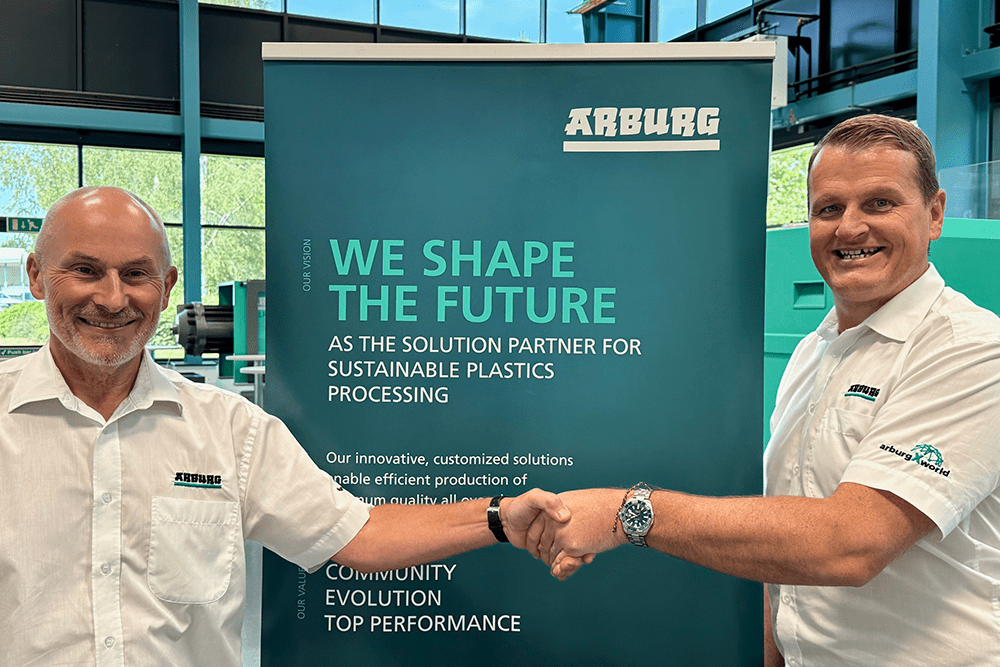
[PM] When did you know it was the right time to start planning retirement? Are you looking forward to it?
[CT]: “There was no one particular moment, I think it just dawned on me, I’ve been here for 27 years. I think I’ve put a reasonable shift in, I’ve done everything I wanted to, everything I could imagine when I joined 27 years ago. Maybe it’s time for some fresh ideas, some different approaches.
“We’ve been putting these changes into action for some time now and it’s so great to see, with Steve, and Alex Gall our Aftersales Manager, we’re planning for the future already, and the company is in a fantastic position.
“Personally, yes, I’m looking forward to it. I’ve loved my career, my time at Arburg, but frankly, it’s time to do other things. I’m very much looking forward to it, and I’m totally ready.”
[PM] What qualities were you looking for in a successor? How is Steve suited to the role?
[CT]: “Well, first and foremost, Steve has fantastic experience in the industry. He knows plastics, he knows moulding machines, he understands our culture and philosophy and knows a lot of people in the industry, which is a great advantage.
“Secondly, Steve is an incredible motivator. I’ve seen that over the last year he’s been here. He galvanises people together. He understands our culture, the honesty, the straight talking, and he brings excellent, fresh ideas. That’s perfect for us, he’s very personable, he’s easy to get on with, what you see is what you get, and he’ll be fantastic in the role. The company and the team are in great hands, no doubts about that.”
We spoke to Steve Thomson for a comment on Colin and the future of Arburg UK.
[ST]: “I’d like to thank Colin and offer him congratulations for everything achieved over the last 45+ years in plastics. I feel like Colin and I share a lot of similarities, both leaving school at 16 and starting a similar career path with an apprenticeship and having a similar personality and outlook.
“I’m looking forward to my new role, and I feel like my 28 years in plastics have given me a good grounding to take on the role of Managing Director from Colin. I look positively to the future and I’m confident that Arburg and I can together successfully navigate whatever the future brings.”
Personal Reflection and Legacy
Colin is an incredibly humble character, and discussing his legacy didn’t come naturally. The questions about his legacy were never met with answers about himself, his skills or achievements, but of the team coming through and his pride in empowering them. He values the apprentices he supported and the customers who became friends. He wants to be remembered as someone fair, honest and reliable.
[PM]: So, what would you say is your greatest achievement in your career?
[CT]: “It’s hard to think of one moment. I’m not good at this sort of thing. Honestly, I’d have to say, supporting people and seeing people progress. It goes back to the start of my career, starting as an apprentice and moving up from there. Seeing the progress and the development of people here is incredibly rewarding.
“Alex Gall, for example, was a service engineer for 10 years, then moved to become after-sales manager. For many years, I had in mind for him to progress to this position, and after interviews with German,y I was so pleased that he got the job. Matt Faries is another example, he’s been with us 11 years, and he will replace Roger Talbo,t our customer service coordinator, in May. Matt started as an apprentice too. Another apprentice, Joe McKenna, just qualified as a service engineer.
“I think there’s synergy there with my career and how I started out. And I think it’s so important, now more than ever, that we train these people, develop their careers, retain and build on the skills within the industry. I’m very proud of how Arburg and I have supported this in the UK.”
Colin was recognised for his contributions at the Plastic Industry Awards 2025 – winning the ‘Plastics Industry Ambassador Award’. Voted for by a panel of industry experts, it is a perfectly fitting tribute to bow out to, only a week from Colin’s final days at Arburg.

Plans for Retirement
Retirement for Colin will not be a quiet affair. We interviewed Colin for the PlastikMedia HotSeat back in 2018, and he mentioned running, road cycling and travel as his priorities outside of work, and that hasn’t changed.
[CT]: “I don’t want to slow down completely, I just need to redirect my energy, keep busy, keep structure and purpose in my life. Cycling? Yes. Running? Yes. Travelling? Yes. My wife and I have just bought a motor home, and we’re planning trips around the Scottish and Irish coasts, and then France, Spain, Italy and Portugal. I’d like to learn a language. Italian is a beautiful language, I’m sure I can ‘butcher’ that, like I do German!
“I would also like to mention Michelle, my wife, who I must give credit to for supporting me for the last 20 years. She has made many sacrifices over that time, so this will not be the case in the future!’
“And after that, who knows? I’m often asked if I’ll do consultancy, or mentoring, or something like that. At the moment, no plans, but who knows in the future? I’d like to volunteer, I like the idea of mentoring and developing people, but I want to enjoy my retirement and rest, too.”
[PM]: If you hadn’t joined the industry, what do you think you’d be doing now?
[CT]: “The forces, for sure. A very quick answer. I’ve done a lot of reflecting recently, and yes, if I hadn’t joined Daniels, there’s no doubt I’d have joined the armed forces. I’ve got a lot of friends who are ex-forces, mostly retired now, but yes, I think that would have suited me. Again, I like the discipline, the physical activities, so I think something engineering-related in the forces would have suited me very well.”
[PM]: And finally, one thing you’ll miss, and one thing you won’t miss?
[CT]: “The people, for sure. I’ll miss the people I’ve worked with and the achievements we’ve made together. That feeling of working on a project, winning the project, and achieving the outcome. That satisfaction is something I’ll miss.
“For something I won’t miss… I think I’m looking forward to some relaxation. Away from the targets or pressures. I’ll set my own targets, riding long distances whenever I like, for instance. I think I’d enjoy that a lot more!”
[PM]: Any parting comments?
[CT]: “Just to end on a positive note, really. I know the market has been tough, and we’ve not had the easiest few years as an industry. But trust me, people are investing in machines, and projects are taking off. We all want to see the global economy improve, and it will. I hope for the best for the people coming through, for Arburg and the wider market. This is a fantastic business that we work in, and I’ve got every confidence in the companies and the people within it to make the future as successful as possible.
“I feel like I’m leaving Arburg in a great position, and I’ve got every confidence in Steve and the wider team coming through to build a successful future.”

For the past few years, Colin, thank you, and from everyone at PlastikCity, we wish you a happy, healthy and fulfilling retirement, well earned!
Read more news from ARBURG here.

ARBURG
01926 457000
Email
Website