WITTMANN Linear Robots Replace Six‑Axis Systems at Rauschert Steinbach
 Dan Russell
- 6 minutes read

|
Getting your Trinity Audio player ready...
|
For Rauschert Steinbach, WITTMANN linear robots have almost completely replaced six-axis robots in the plastics processing shop. The new automation concept enables maximum flexibility, with the W828 model playing an essential part.
The plug components being passed around in the conference room during a visit to Paul Rauschert Steinbach GmbH, based in Steinbach am Wald in Southern Germany, are quite complex. They consist of fiberglass-reinforced Polyamide with contact pins pressed in. The parts are destined for use in automobile air suspension systems. In fact, there are two plug models involved, which are being produced inside a 1+1-cavity mould on a 100-ton injection moulding machine. A total of 600,000 units are leaving the plant each year.
For a long time, these plugs were manufactured semi-automatically. “Between work steps, there was much idle time for the operating staff “, reports Tobias Büchner, Rauschert’s Production Manager. With the more stringent quality standards and pressure for more cost efficiency, this approach was no longer viable. “It became clear to us that we needed to introduce more automation”, says Büchner.
Today, the plug housings are produced fully automatically. There is now less manual work, and the idle times have been eliminated. The production staff can now be employed much more efficiently. This successful move towards automation was part of a comprehensive standardisation project, which Rauschert has implemented across its entire plastic parts sector to maximise flexibility and efficiency.
Automation for a great variety of demands
As a family-run business with two facilities in Germany, as well as several international subsidiaries, Rauschert has been a leading developer and producer of ignition components, engineering ceramics and moulded plastic parts for 125 years. “With our value chain across three interconnected production segments, including in-house tooling and plant manufacturing, we are unique worldwide”, says Udo Jakob, Purchasing Manager at Rauschert, and emphasises: “Plastic valve bodies with VOSS threading are one of our special strengths.” Rauschert products are used in household, heating, electrical and high-temperature technologies, as well as in the automotive sector.
The injection moulding equipment at the facility in Steinbach consists of 28 machines. Visitors immediately notice the equipment’s clear-cut structure and uniform appearance. The 14 most recently acquired injection moulding machines are all already equipped with a standardised automation cell. Its core in each case is a WITTMANN W828 linear robot. “We have designed and built the automation cells ourselves. Thanks to standardisation we were able to install the automation very quickly. That is precisely the strength of this system”, Jakob points out.

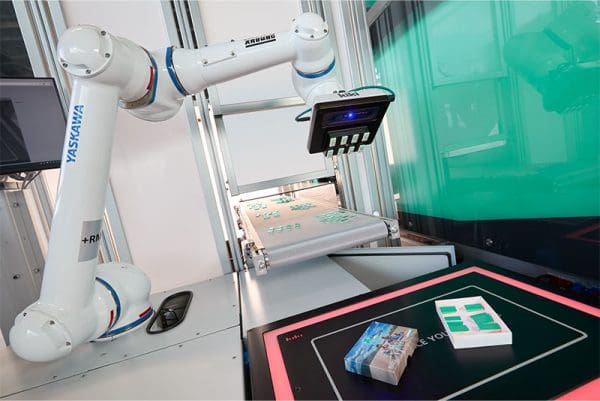
The automation cells all include the robot’s working area, an automation station for insertion, assembly and inspection tasks, feeder units and the outfeed conveyor belt, which is laid out to accommodate boxes of different shapes and sizes, including even Euro pallets. “Everything is now possible from manual removal right up to complex, fully automatic insertion jobs”, comments Alexander Förtsch, Maintenance Manager at Rauschert in Steinbach am Wald, with pleasure.
Robots as masters of the entire cell
The plugs for the air suspension systems in vehicles fully exploit the potential of the standardised automation cells. The manufacturing process starts with the preparation of the pins and the injection moulding of the plug housings. The W828 linear robot then demoulds the housings and passes them on to fully automatic downstream processing. Here, the pins are fused with the housings and then presented to a camera for 100 per cent inspection.

“The crucial point of our new standard is total integration into the control system,” emphasises Büchner. “In each case, the WITTMANN linear robot is the master of the downstream work steps following injection moulding.”
“The openness of the WITTMANN system is something special”, underscores Manuel Rommel, CIP Manager for moulded plastic parts at Rauschert. “We discussed this concept with various robot manufacturers. Only WITTMANN was able to offer this integrated solution without any additional control device.”
With the new automation cells, the Rauschert team has managed to create a standardised automation system which covers a great variety of different requirements. This is necessary, for they have a total of more than 300 moulds in active use, and their customer base is heterogeneous. “The number of units ranges from 500 up to 3 million”, is how Büchner describes the challenge.
“That requires great flexibility. We also find it important to have some backup options. In this way, we ensure continuous delivery capability. If one of our machines has an unplanned standstill, we can quickly transfer the mould and the automation system involved to another machine. Thanks to standardised automation, this is possible without any problems – similar to ‘plug and play’.”
Setup times minimised
In regular operation, too, short setup times make an important contribution to competitive overall efficiency. Four or five setups are carried out in every shift. “Since the startup of our standardised automation cells, we can also begin production of a new batch during the night shift, when there is only one machine setter on site. All the setter has to do is just load the program without having to program anything himself”, Förtsch emphasises. “Previously, setups were only possible during the day, when the fixture construction team was present.”
Particularly large time consumers were the six-arm robots, which were formerly more frequently in use inside the injection moulding hall, before the standardisation process. “Following the setup, we were often still busy with teaching for a considerable time. With the linear robots, by contrast, many steps happen intuitively, and therefore much faster”, reports Rommel.
The standardisation project has significantly increased both flexibility and productivity of the injection moulding production at the plant in Steinbach am Wald, and simultaneously improved the consistency of quality as well. An additional benefit is greater sustainability. “Through the optimisation of setup times, we are now able to utilise our production cells more effectively, which has a positive effect on our energy balance”, explains Tobias Büchner. The objective of a new project will be to calculate the CO2 footprint for every plastic product. For this aspect, too, is becoming an increasingly decisive factor for competitiveness.
Read more from Wittmann Battenfeld here.

Wittmann Battenfeld UK
01933 275777
Website
Email