Injection Moulding Headaches Part 7: Weld Lines (and How to Fix It) // Alliance Tooling
 PlastikMedia Guest
- 2 minutes read

|
Getting your Trinity Audio player ready...
|
Here’s another defect that can quietly weaken a moulded part. This week’s issue is weld lines (weld joins).
This is the seventh instalment in Alliance Tooling’s weekly series, where the company break down common moulding problems and looks at how to prevent them through better tooling and process decisions.
The problem: weld lines
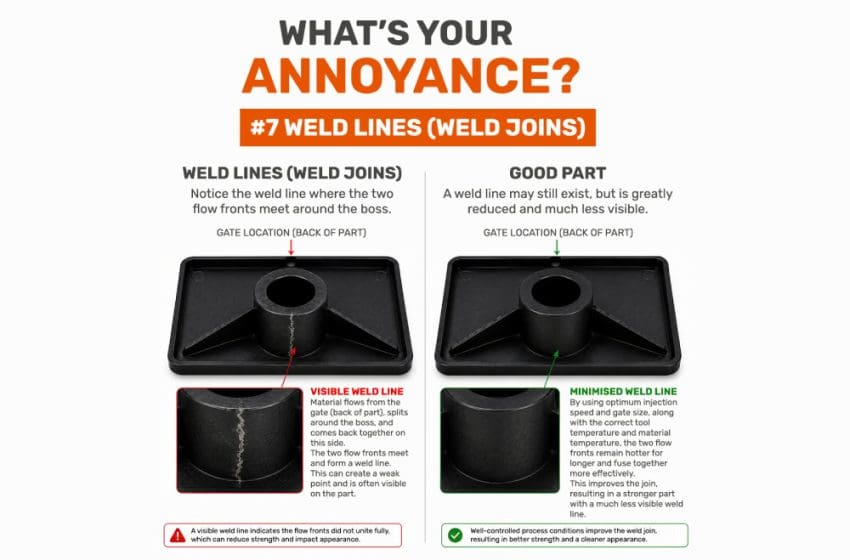
Weld lines are visible lines that appear where two flow fronts of molten plastic meet inside the mould.
In some cases they are purely cosmetic. In others, they create structural weak points that affect part performance.
Weld lines commonly appear around:
- Holes
- Bosses
- Inserts
- Multiple gate locations
- Complex flow paths
If not properly controlled, weld lines can:
- Reduce part strength
- Create cosmetic defects
- Cause cracking or failure under load
- Lead to inconsistent product quality
Why do weld lines happen?
Weld lines form when two separate flows of molten plastic meet but fail to bond together properly.
This usually happens because the material cools too much before the flow fronts combine.
Common causes include:
- Low melt temperature
- Poor gate placement
- Slow injection speed
- Long or complex flow paths
- Insufficient venting
- Material cooling too quickly around holes or features
How to design it out (before tooling even starts)
Good part and tool design can significantly reduce weld line problems before production begins.
At Alliance Tooling, we focus on:
- Optimising gate location for balanced flow
- Designing flow paths to minimise opposing fronts
- Improving venting in weld line areas
- Controlling wall thickness transitions
- Designing tooling around material flow behaviour
- Identifying cosmetic and structural risk areas early
Already seeing weld lines? Here’s how to fix it
If weld lines are already appearing in production, several process and tooling adjustments can help improve the result:
- Increase melt temperature
- Increase injection speed
- Optimise mould temperature
- Improve venting near weld areas
- Modify gate location or gate size
- Adjust process settings to improve flow front bonding
- In some cases, tool modifications may be required
Where Alliance Tooling come in

Weld lines are often accepted as an unavoidable part of moulding, but many can be reduced or eliminated through better tooling and flow management.
At Alliance Tooling, we:
- Analyse how material flows through the tool
- Identify weak or high-risk weld areas
- Design tooling for stronger, cleaner mouldings
Read more news from Alliance Tooling here.

+44(0)116 275 0584
Website
Email